
Nissin Demae Iccho: Hong Kong Flavours and History
Explore Nissin Demae Iccho through brand history, flavour choices, preparation and Hong Kong label information.
Nissin Demae Iccho: Hong Kong Flavours and History
Demae Iccho (出前一丁) is a Nissin instant noodle launched in Japan in 1968 and sold in Hong Kong since the late 1960s, where it has grown into a local staple with a flavour range far wider than the Japanese original. The signature is the small sachet of sesame-flavoured oil; in Hong Kong the brand is made locally and its flavour line-up is developed for Cantonese tastes. It appears on cha chaan teng menus, in office drawers and in most supermarkets across Hong Kong.
This page is for shoppers and visitors who want to understand what Demae Iccho is, how the Hong Kong range differs from the Japanese one and how to cook a packet well. It is part of our hub on instant noodles in Hong Kong, which explains packets, cups, bowls and the local brands side by side.
The label rule. Demae Iccho is a brand family, not one noodle. Check the flavour name, the noodle type (standard fried, or the non-fried and thicker variants) and the Hong Kong nutrition label before assuming two packets cook or taste the same.
📜 1. Where the brand came from
Nissin's own corporate history records Demae Iccho as a 1968 Japanese launch, a decade after the company's founder Momofuku Ando introduced Chicken Ramen. The name translates roughly as one order for delivery, and the mascot, a boy carrying a tray, plays on that idea. The product was designed to stand apart through a separately packed sesame oil rather than through a new soup base.
Sources disagree slightly on the Hong Kong arrival date. Nissin-linked accounts describe exports beginning around the Japanese launch, while an English-language encyclopaedia entry places the Hong Kong market entry the year after the Japanese release. Treat the late 1960s as reliable and any single year as approximate. Nissin Foods was incorporated in Hong Kong in 1984 and completed a plant in Tai Po the following year, after which local production replaced imports.
🇭🇰 2. Why it became a Hong Kong staple
Three factors appear repeatedly in accounts of the brand's local success: early arrival before strong competition, a flavour that suited Cantonese soup noodle habits, and adoption by cha chaan tengs as a breakfast and set-meal noodle. The breakfast tradition has its own page, cha chaan teng instant noodles and the Demae Iccho breakfast. For the wider story of how Japanese noodles entered the city, see the history of ramen in Hong Kong.
A claim that the brand holds about half of the Hong Kong instant noodle market circulates in Japanese and English fan sites. We could not find a current primary source for that figure, so treat it as an industry claim rather than a verified statistic. Nissin's 2026 interim results describe the group as the largest instant noodle company in Hong Kong, which is the operator's own statement.
🍜 3. The Hong Kong flavour range
Nissin Foods Hong Kong's product pages list a range that changes over time. Flavours commonly stocked in Hong Kong supermarkets at the time of research include:
- Sesame oil flavour, the original and the reference point
- Tonkotsu and Kyushu-style pork bone flavours
- Spicy tonkotsu and chilli variants
- Black garlic oil tonkotsu
- Chicken and shrimp flavours
- Thai-style tom yum and other Southeast Asian flavours
- Satay and beef flavours aimed at Cantonese tastes
- Non-fried noodle versions and thicker-noodle premium lines
- A scallop and salt soup flavour listed as a 2026 new product in Nissin's interim results
Not every flavour is available at every outlet, and seasonal or limited editions appear and disappear. The flavour sold in Japan under the same name is primarily the sesame oil version, so Hong Kong travellers often find the Japanese shelf narrower than the one at home.
🥣 4. How to cook a packet well
- Boil about 500 ml of water; the packet suggests a volume, but less water gives a stronger soup.
- Add the noodle cake and cook for about three minutes, loosening with chopsticks after one minute.
- Turn off the heat, then stir in the soup powder; adding it earlier makes the water foam and can over-reduce.
- Add the sesame oil sachet last so the aroma stays bright.
- Finish with a fried egg, luncheon meat, spring onion or choi sum, cha chaan teng style.
Dry versions are also common at home: drain the noodles, toss with a little of the soup powder and all the oil, and serve with a fried egg. More ideas are in our instant noodle recipes and instant ramen hacks.
❤️ 5. Sodium and what the label says
Instant noodles are high in sodium, and Demae Iccho is no exception. In February 2024 the Hong Kong Consumer Council tested 19 pre-packaged instant noodle samples and found that eating a whole serving, including soup, delivered between 1,509 mg and 2,477 mg of sodium, with every sample exceeding the recommended adult limit for one meal. Hong Kong's Centre for Food Safety has separately reported sodium figures ranging from 834 mg to 5,800 mg per 100 g across 48 products. Check the specific packet's label; the figures for individual flavours vary. Our page on instant noodle calories and sodium explains how to read the label, and healthier instant noodle choices covers practical reductions such as using half the powder and leaving the soup.
Clear broth is not low salt. A light-coloured soup can carry as much sodium as a dark one. People with hypertension, heart or kidney conditions, and anyone who is pregnant, should treat instant noodles as an occasional food and speak to a doctor or registered dietitian about their sodium intake. This page is general information, not medical advice.
🛒 6. Where to buy and price tier
Demae Iccho sits in the lower price tier in Hong Kong supermarkets and convenience stores, with multi-packs usually cheaper per packet than singles. Premium non-fried lines sit a tier higher. Prices change frequently; check the shelf. For comparison with Korean and Japanese imports, see our Korean instant noodle buying guide and the ramen shopping hub.
❓ 7. FAQ
Is Demae Iccho the same as Demae Ramen? Yes. Demae Iccho is the Japanese and Hong Kong name; Demae Ramen is the label used in some export markets.
Where is Hong Kong Demae Iccho made? Nissin Foods Hong Kong operates a plant in Tai Po, opened in 1985 according to the company's history. Check the packet for the production site, as some premium lines are imported.
Why does the Hong Kong range have so many flavours? Nissin's local subsidiary develops flavours for Hong Kong tastes, which is why tonkotsu, satay, tom yum and seafood lines appear here but not in Japan.
Is the sesame oil sachet essential? It is the brand's defining feature, but you can halve it to reduce fat or swap it for your own spring onion oil.
Is Demae Iccho healthier than other instant noodles? No single brand can be called healthy. Compare the sodium, fat and energy figures on each Hong Kong nutrition label and treat all fried instant noodles as occasional foods.
instant noodles Hong Kong best instant noodles Hong Kong Nissin Demae Iccho Doll noodles Buldak ramen Shin Ramyun Samyang noodles Jin Ramen cup noodles instant noodles ranking instant noodles recipe instant noodle calories
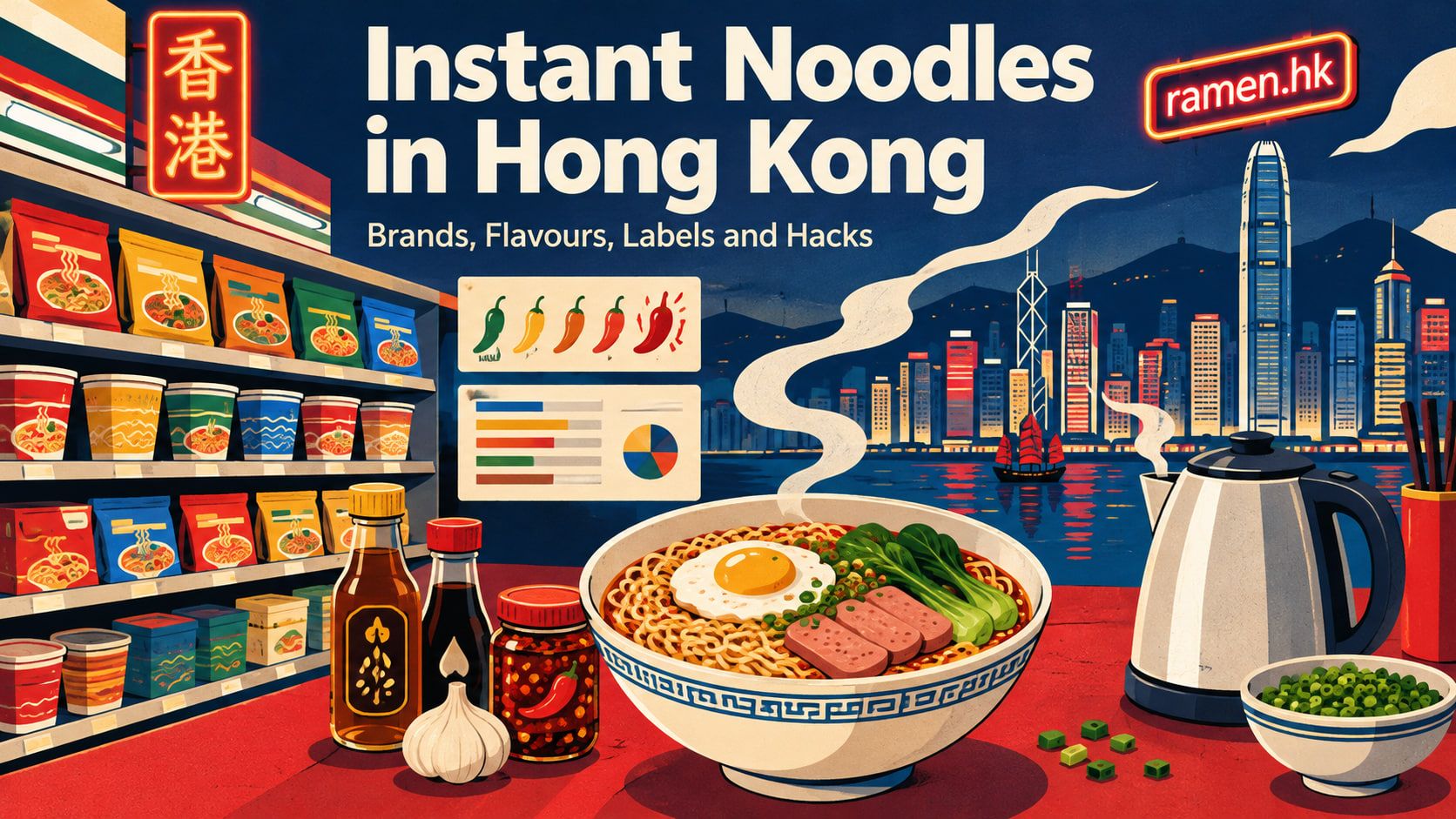
Go beyond packet rankings with Hong Kong brand history, heat levels, nutrition labels, better cooking and pantry upgrades.
Understand cha chaan teng instant noodles through meal formats, toppings and the ordering questions Hong Kong diners ask.
Explore Doll noodles through Hong Kong brand context, product formats, cooking directions and label checks.
Understand Buldak noodles through exact flavours, sauced formats, heat descriptions and pack-specific preparation.
Explore Buldak Carbonara through its flavour format, cooking instructions and ingredient checks, without assuming creamy means mild.
Understand Shin Ramyun through its product family, preparation instructions and nutrition information on the pack.
Explore Samyang noodles beyond a single flavour by comparing formats, preparation methods and imported labels.
Compare Jin Ramen variants through exact product names, heat descriptions, cooking methods and labels.
Explore Cup Noodles through product history, flavour choices and the fill-line and preparation instructions on each cup.
Navigate Korean instant noodles through soup and sauced formats, flavour families and practical shopping checks.