
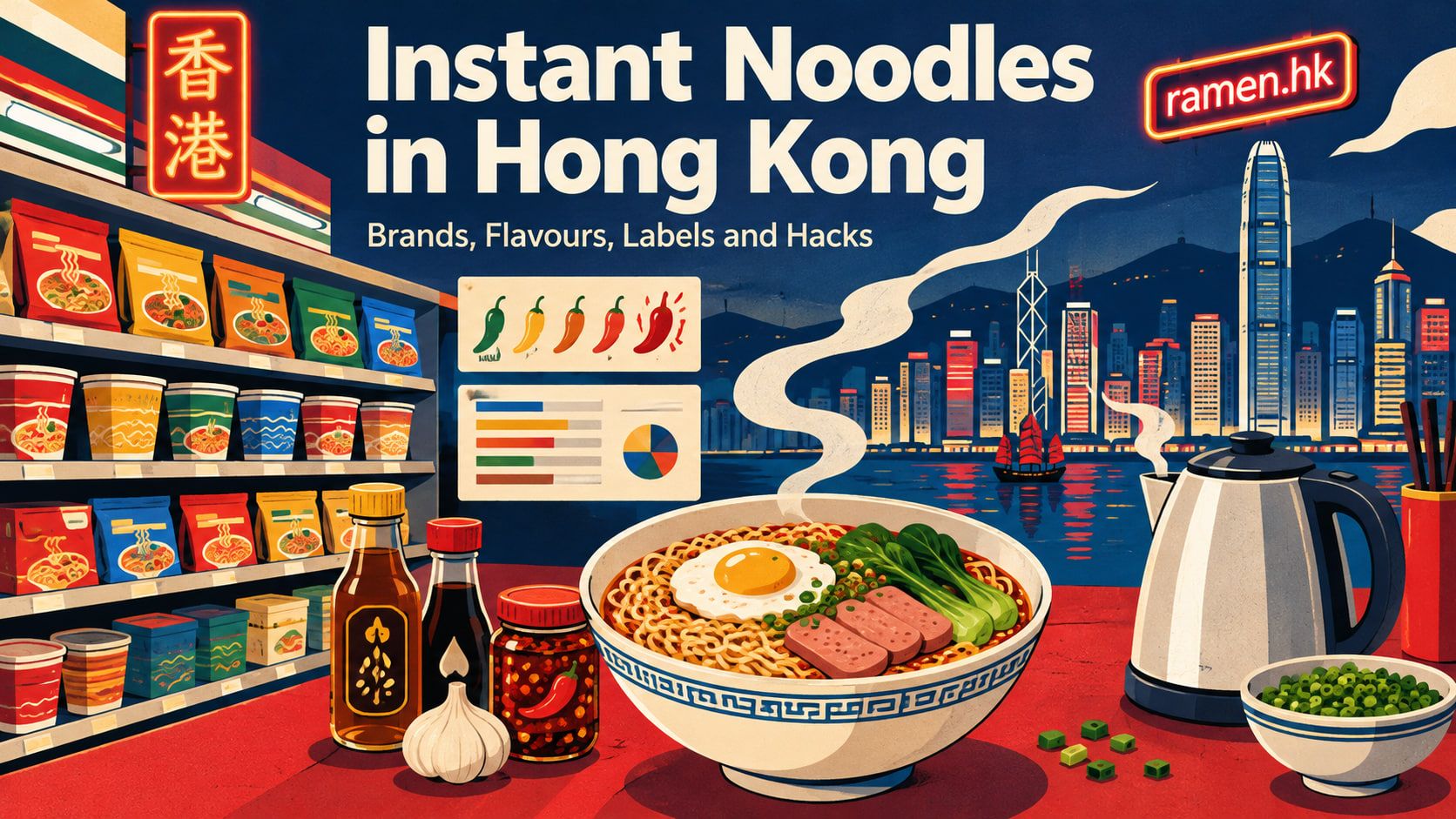
Instant Noodles in Hong Kong: Brands, Flavours, Labels and Hacks
Go beyond packet rankings with Hong Kong brand history, heat levels, nutrition labels, better cooking and pantry upgrades.
Instant Noodles in Hong Kong: Brands, Heat Levels, Labels and Better Cooking
Go beyond packet rankings with Hong Kong brand context, clear product comparisons and useful pantry upgrades.
Highlight key: products and terms · practical choices · price and portion · limitations
Choose instant noodles by the exact product, not just its brand or packet colour. First identify the format, cooking method and portion; then compare flavour, heat, nutrition and the full cost of your meal. A soup packet and a drained-sauce product need different preparation even when their packaging looks similar.
This hub connects Hong Kong favourites, Korean product families, heat questions, label reading and home upgrades. It is not a tasting league table or a live stock service. For restaurant ramen and the wider site, return to Ramen in Hong Kong.
Start with the task:
Choosing a familiar Hong Kong product → read the brand and café-context guides.
Trying a Korean product → check whether it is soup-based or drained and sauce-mixed.
Choosing heat → identify the exact flavour and version, not just the colour.
Comparing nutrition → match the label basis and count the whole amount you eat.
Improving a packet meal → cook toppings safely and follow the noodle instructions.
🍜 1. Hong Kong brands and everyday uses
Brand history, a retail packet and a café dish answer different questions. A historical association does not establish today’s ingredients, pack weight or price; a restaurant serving instant noodles may also add its own stock, oil and toppings.
- Nissin Demae Iccho: brand context, product versions and preparation enquiries.
- Doll noodles: a separate brand-specific reading route.
- Cha chaan teng instant noodles: café ordering and combinations, rather than a retail specification.
- Cup noodles: format, preparation and container questions.
- Momofuku Ando: the invention story, separate from current product comparisons.
A café menu name does not necessarily identify the retail brand or flavour used. If that matters, ask before ordering rather than transferring a packet’s label to the restaurant meal.
🌶️ 2. Korean product families and heat levels
Read the product’s full name, format and preparation method. For a drained product, check how much water to retain and when to mix in the sauce. For soup noodles, check the required water and cooking sequence.
Korean instant-noodle overview · Shin Ramyun · Samyang products · Jin Ramen
Heat tolerance is personal. A creamy or carbonara description is not a chilli-free claim, and online Scoville figures should not be treated as precise unless they match a reliable specification for that product. Start cautiously with unfamiliar flavours rather than treating the meal as a challenge.
Buldak guide · Buldak Carbonara · How spicy is Buldak? · Buldak vs Shin Ramyun
🏷️ 3. Compare labels on the same basis
Before comparing sodium or calories, identify whether the figures refer to each 100 g/mL, each serving or the whole pack. Then check the number of servings and whether values describe the product as sold or prepared.
- Match the reference amount before comparing products.
- Check whether seasoning, sauce and oil are included in the figures.
- Count the full portion you will eat, not automatically one labelled serving.
- Record additions such as egg, cheese and meat separately.
- Read ingredients and allergen information as well as nutrition values.
The CFS and Consumer Council article published in March 2010 examined 48 products whose labels included noodles and seasonings. It advises choosing products lower in sodium, total fat and saturated fat, reducing seasoning and drinking less soup.
That sample is historical, not a current product ranking or proof that every label today includes the same components. Non-fried noodles are not automatically low in sodium. Using half a seasoning sachet does not prove that the whole meal’s sodium is halved.
Instant-noodle calories and sodium · Making better-informed choices · Sodium context
🍳 4. Better cooking: follow the pack, then improve the meal
Check water quantity, cooking time, drainage and sachet order before starting. Packet, cup and bowl versions are not interchangeable methods. Do not assume a cup or lid is microwave-safe unless the product explicitly permits that use.
For an upgrade, choose one or two additions that fit your equipment and time. Prepare ingredients that need longer cooking first; do not expect residual noodle heat to cook raw meat or egg safely. Cheese, milk, egg and other additions also change allergens, portions and nutrition.
Instant-noodle recipes · Practical upgrades · Cheese ramen · Food-safety guidance
🛒 5. Buy the quantity you can use and record what worked
Compare the total delivered price, pack count, weight and actual servings. A family pack may reduce unit cost, but only helps if you can store and finish it as directed.
Photograph the exact product name, format, ingredients, label and instructions. A new regional import or cup version may differ from your familiar packet. Keep the packaging until cooking is complete so you can recheck instructions.
Shopping routes: Hong Kong ramen shopping · Don Don Donki · Kit alternatives. These pages do not guarantee current branch stock.
❓ 6. FAQ and sources
Which instant noodle is best?
Choose the format, flavour, portion and preparation that suit you. If using a ranking or comparison, check the criteria, products tested and date rather than treating taste preference as universal.
Does adding more water reduce total sodium?
Not if the noodles and seasoning stay the same and you consume all the liquid. More water lowers concentration, not the original sodium total.
Can I use one flavour’s instructions for another?
Do not assume so. Check the actual pack, especially when changing between soup and drained-sauce formats.
Nutrition background and practical seasoning advice reference the CFS article published in March 2010. Historical samples are not presented as current test results. This hub does not claim product tastings, laboratory testing, verified heat measurements or live retail stock. Follow the exact pack and seek professional advice for personal medical diets.
"