
Momofuku Ando and the Invention of Instant Noodles
Explore Momofuku Ando’s life and work through instant-noodle history and the inventions associated with his career.
Momofuku Ando and the Invention of Instant Noodles
Momofuku Ando, born Go Pek-hok in Japanese-ruled Taiwan in 1910, founded Nissin and brought the first commercial instant noodle, Chikin Ramen, to market on 25 August 1958, at the age of 48. He followed it with Cup Noodle on 18 September 1971, and the two products between them created the category that fills Hong Kong supermarket aisles and cha chaan teng breakfast menus today. He died in Ikeda, Osaka, in January 2007, aged 96.
This page is for readers who want the documented story behind the packet, separated from the legends that have grown around it. It sits under the hub on ramen culture and history and connects to instant noodles in Hong Kong, where his inventions arrived within a decade.
The one-line answer. Ando did not invent ramen; he invented a way to flash-fry pre-cooked noodles so they could be stored dry and revived with hot water in minutes. That industrial step, not a recipe, is the invention.
👤 1. Early life and the road to Osaka
Ando was born on 5 March 1910 in Chiayi, Taiwan, then a Japanese colony, and raised by grandparents who ran a textile shop in Tainan after his parents died. At 22 he started a textile business in Taipei, and in 1933 moved to Osaka, where he ran a clothing company while studying economics at Ritsumeikan University. After the Second World War he chose Republic of China citizenship to keep family property in Taiwan, then naturalised as Japanese in 1966, taking his wife's surname Ando. Momofuku is the Japanese reading of his given name.
His business life before noodles was turbulent. He was convicted of tax evasion in 1948 and served two years; his biography describes the offence as arising from student scholarships he had funded. A later bankruptcy left him with little beyond a small salt-making operation in Ikeda, Osaka, which became the seed of Nissin.
🍜 2. Chikin Ramen, 1958
Post-war Japan faced food shortages, and the Ministry of Health promoted bread made from American wheat. Ando is widely quoted as asking why noodles, a familiar food, were not promoted instead, and being told that noodle makers were too small to supply the country. In a backyard shed he spent months on trial and error before settling on flash-frying cooked noodles in oil, which dried them and created pores that let hot water rehydrate them quickly. Chikin Ramen went on sale on 25 August 1958 at 35 yen, about six times the price of fresh udon at the time, and was initially a luxury. The product is still sold in Japan. How it relates to the restaurant dish is on the history of ramen and is ramen Japanese or Chinese.
A frequently repeated story credits his wife's tempura frying with inspiring the method. It appears in company and museum materials but we could not find a contemporaneous primary source, so treat it as a widely attributed anecdote.
🥤 3. Cup Noodle, 1971
According to accounts cited by the Financial Times and others, Ando observed American buyers breaking Chikin Ramen into paper cups and eating it with forks during a 1966 trip. The result, launched on 18 September 1971, was a tapered polystyrene cup with the noodle block suspended mid-way, hot water added through the lid. Television coverage of police eating Cup Noodle during the 1972 Asama-Sanso siege is often credited with boosting awareness in Japan, a conjecture rather than a measured effect. Nissin brought the format to Hong Kong through its local subsidiary in the 1980s; see Cup Noodles in Japan and Hong Kong compared.
🏭 4. Building an industry
- 1964: Ando founded Japan's Instant Food Industry Association, which introduced standards such as production dates on packaging and the fill line.
- 1997: he founded the International Ramen Manufacturers Association, now the World Instant Noodles Association.
- 2005: Nissin developed Space Ram, a vacuum-packed noodle for a Japanese astronaut on the Space Shuttle Discovery, an episode recorded in Nissin's history.
- Honours included the Order of the Rising Sun, Gold and Silver Star, in 2002.
Hong Kong's own instant noodle industry grew in parallel: Winner Food Products launched Doll noodles in 1968, and Nissin began local production in Tai Po in 1985 before acquiring Winner in 1989. That story is on the Doll noodles page and the Demae Iccho page.
🏛️ 5. Museums and legacy
Two Nissin museums tell the story: the Cup Noodles Museum in Ikeda, Osaka, built around a recreation of his shed, and the Cup Noodles Museum in Yokohama, opened in 2011. Visitors can assemble a custom cup at both; access and ticket rules are on our Yokohama Cup Noodles Museum page. Ando is said to have eaten Chikin Ramen almost daily into old age, a claim from company accounts and obituaries rather than a medical record. The World Instant Noodles Association publishes annual demand figures that run to more than a hundred billion servings worldwide; check its current release for the latest number.
Separate the documented record from the legend. Many details of Ando's story come from Nissin's own museums and his autobiography, and some anecdotes have no independent source. Dates of product launches, his birth and death, and his honours are well documented; the tempura inspiration, the American paper-cup moment and the daily-ramen claim are widely repeated but not independently verified. Treat the latter as company narrative.
❓ 6. FAQ
Did Momofuku Ando invent ramen? No. Ramen as a restaurant dish existed in Japan from the early twentieth century, with Chinese roots. Ando invented the instant, shelf-stable version.
Was Ando Japanese or Taiwanese? Both, at different times. He was born in Japanese-ruled Taiwan, held Republic of China citizenship after 1945 and became a Japanese citizen in 1966.
Is Chikin Ramen still sold? Yes, in Japan, and it appears in some Hong Kong Japanese supermarkets and Don Don Donki as an import.
What is the connection to the Momofuku restaurants? The American restaurant group founded by David Chang took its name as a nod to Ando; there is no corporate link.
Where can I see his workshop? A recreation is at the Cup Noodles Museum in Ikeda, Osaka, near Nissin's origins; Yokohama has a second museum with a larger visitor programme.
instant noodles Hong Kong best instant noodles Hong Kong Nissin Demae Iccho Doll noodles Buldak ramen Shin Ramyun Samyang noodles Jin Ramen cup noodles instant noodles ranking instant noodles recipe instant noodle calories
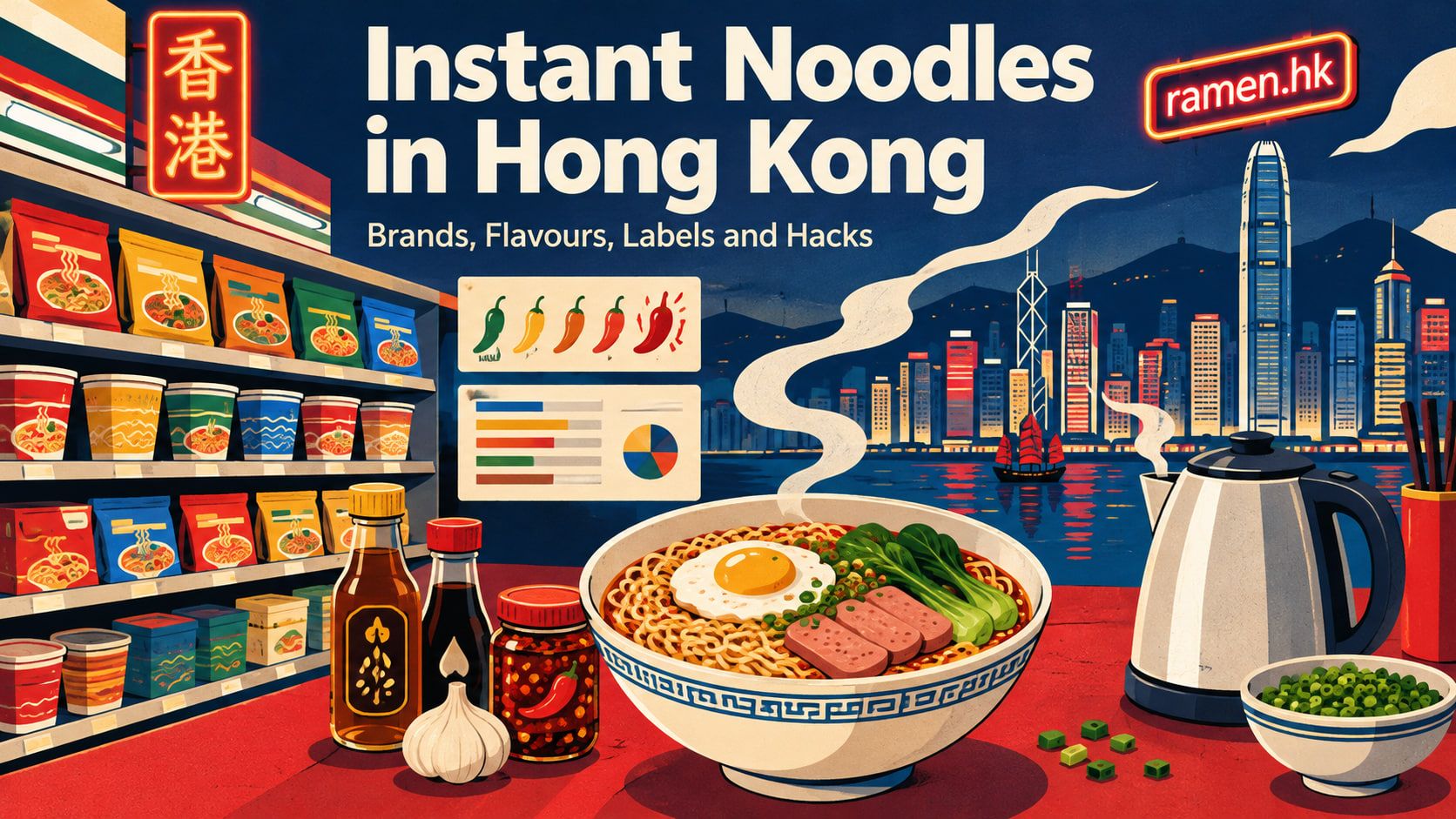
Go beyond packet rankings with Hong Kong brand history, heat levels, nutrition labels, better cooking and pantry upgrades.
Explore Nissin Demae Iccho through brand history, flavour choices, preparation and Hong Kong label information.
Understand cha chaan teng instant noodles through meal formats, toppings and the ordering questions Hong Kong diners ask.
Explore Doll noodles through Hong Kong brand context, product formats, cooking directions and label checks.
Understand Buldak noodles through exact flavours, sauced formats, heat descriptions and pack-specific preparation.
Explore Buldak Carbonara through its flavour format, cooking instructions and ingredient checks, without assuming creamy means mild.
Understand Shin Ramyun through its product family, preparation instructions and nutrition information on the pack.
Explore Samyang noodles beyond a single flavour by comparing formats, preparation methods and imported labels.
Compare Jin Ramen variants through exact product names, heat descriptions, cooking methods and labels.
Explore Cup Noodles through product history, flavour choices and the fill-line and preparation instructions on each cup.