

Ramen Situations in Hong Kong: Late Night, Budget, Solo and Delivery
Choose ramen according to the moment: late shift, tight budget, solo lunch, family outing or rainy-night delivery.
Ramen by Situation in Hong Kong: Late Shifts, Tight Budgets, Solo Meals, Families and Delivery
Choose ramen according to the moment: late shift, tight budget, solo lunch, family outing or rainy-night delivery.
Highlight key: prices and charges · practical actions · limitations and cautions · locations and timing · seating and service terms
The right ramen meal often depends less on the most famous name than on what the occasion requires. A late shift needs a realistic last-admission time; a family needs seating and access; a tight budget needs the complete bill; a rainy-night order needs delivery coverage and packaging that suits the bowl. The same broth preference can lead to different choices in each case.
This sub-hub organises those situations and directs you to focused Ramen.hk guides. It uses official Ichiran branch information as a worked example of how two branches of one brand can differ. It is not a ranking, live availability service or guarantee that any restaurant suits a particular diner. For the site-wide overview, return to Ramen in Hong Kong; for district and MTR planning, use the ramen location guide.
Start here:
Eating late → confirm last orders, last admission and any time-based surcharge.
Eating alone → check the seating format and how the queue works.
Bringing children → ask about table seating, utensils, chairs and portions.
Spending carefully → compare the full bill for the order you will actually place.
Ordering delivery → check service area, total fees and how noodles and soup are packed.
Managing a dietary requirement → settle ingredient questions before travelling or paying.
🧭 1. Situation quick reference
| Situation | Check first | Common mistake | Focused guide |
|---|---|---|---|
| Late shift | Last orders, last admission, surcharges and the journey home. | Treating closing time as a promise of entry. | Late-night ramen |
| Short break | Queue system, walking time and a nearby fallback. | Joining a long line without a leave-by time. | Ramen queues |
| Tight budget | The full bill for your actual order and channel. | Comparing a basic bowl with a loaded set. | Lower-budget ramen |
| Solo meal | Counter or table seating and ordering method. | Assuming solo diners are always seated faster. | Solo ramen |
| Family outing | Tables, children’s utensils, chairs, pushchair space and portions. | Treating a mall location as a family-friendly guarantee. | Family ramen |
| Rainy-night delivery | Coverage, total fees, packaging and handling instructions. | Assuming platform prices match dine-in prices. | Ramen delivery |
🌙 2. Late shifts and short breaks: three times, not one
Separate three checks: published opening hours, last orders and the point at which new customers stop being admitted. A shop can still be open while no longer accepting new diners, particularly when a queue is long.
Worked example: two Ichiran branches
At the time of research, Ichiran’s official branch pages listed:
- Tsim Sha Tsui: 09:00 to 04:00 the next day, last order 03:30.
- Causeway Bay: 09:00 to 05:00 the next day, last order 04:30.
Both pages state that a late-night surcharge applies from 22:00 to 06:00, but neither branch page lists the amount. The Tsim Sha Tsui page also notes that entry may be refused before last orders when the shop is busy. Treat these as branch-specific examples, not a rule for all late-night ramen in Hong Kong.
Before a late journey, ask: “I expect to arrive at [time]. Will you still be admitting new customers?” That question is more useful than asking only when the shop closes. Plan the journey home before committing to a cross-harbour trip.
Short lunch breaks: set a leave-by time first
Decide the latest time you must leave, then work backwards through walking, queueing, ordering and eating. Choose a fallback in the same building, mall or route. Ramen.hk does not publish live queue lengths and does not claim that any time slot is queue-free. Read the queue guide for ticketing, waiting lists and walk-in systems.
💰 3. Tight budgets: compare the full bill, not the headline price
Calculate the base bowl + toppings you normally add + extra noodles + drinks + service charge + any time-based surcharge. Check minimum spend or set-meal conditions. A low starting price may exclude items included elsewhere.
- Compare the same channel: dine-in, collection and delivery may use different prices.
- Compare equivalent orders: a plain bowl and a loaded set are not the same purchase.
- Count travel: a cheaper bowl across the harbour may cost more in time and fares.
- Read price ranges cautiously: a platform’s spending band is not a current menu quote.
An inexpensive meal is not automatically suitable for a dietary requirement, and Ramen.hk does not publish a sourced citywide average price. Use lower-budget ramen, the full-bill price guide and dated price trends for the detail.
👥 4. Solo diners, families and groups: seating decides more than style
Solo meals: check the seating format
Ichiran Causeway Bay’s official page lists 57 “Flavor Concentration” counter seats and no regular tables, which may suit a solo diner comfortable with booth-style counters. Tsim Sha Tsui lists 58 counter seats and 128 table seats. Seat counts describe the layout, not real-time availability, and this guide has not verified any “solo priority” rule.
If you have large luggage, use a wheelchair or find high stools difficult, ask about the actual seating before queueing. Compare formats in the solo ramen guide.
Families: children’s utensils are not the same as a family table
The Tsim Sha Tsui page mentions a children’s ramen and children’s utensils alongside its table seating; the Causeway Bay page lists counter seats only. Before going, ask about table seating, high chairs, pushchair space, children’s portions, sharing rules and how very hot soup is served. Check allergies separately. Continue with family ramen planning.
Groups: total seats do not mean one table
A large seat count can still mean a counter-led layout where a group sits apart. Ask whether your party can sit together, how long that may take and whether everyone must arrive before seating. One spare stool says nothing about how quickly a whole group will be seated. Compare operators through the restaurant and brand guides.
🧾 5. Dietary requirements: settle them before the journey
Dietary needs should be resolved before travelling, queueing or buying a ticket. Ask about the noodles, stock, tare, aroma oil, toppings and cross-contact separately. Removing visible chashu does not change the stock, and a clear-looking broth does not establish its ingredients.
- Halal: distinguish formal certification from informal “pork-free” or “Muslim-friendly” wording, and check what the certification covers. See halal ramen checks.
- Vegan: check stock, fish-based seasoning, animal fats, egg and dairy. See vegan ramen checks.
- Gluten-free: check noodles, soy sauce, other seasonings and shared cooking water. See gluten-free ramen checks.
- Food allergy: ask about every component and how cross-contact is handled. See ramen allergen questions.
The Centre for Food Safety notes that very small amounts of an allergen can trigger a reaction in sensitive people. If staff cannot give a clear answer, treat the question as unresolved rather than assuming the meal is safe.
☔ 6. Rain, typhoons and delivery: the journey changes the meal
Delivery: texture, total cost and packaging
Before ordering, check the delivery area, platform and delivery fees, estimated arrival and whether noodles and soup are packed separately. Longer journeys give noodles more time to absorb liquid. Tsukemen dipping soup is concentrated and is not necessarily meant to be drunk as broth. Follow the restaurant’s reheating and storage directions; see reheating ramen safely and ramen delivery planning.
Dining out in wet weather: check the route, not the district name
Use MTR station location maps and layouts to identify the exit nearest the building, then confirm the entrance and the restaurant floor. A covered or indoor route should be checked, not assumed from a district or mall name. For mall-based routes, start with IFC and Central malls; for street-level districts, see Causeway Bay or Central.
Typhoon and rainstorm warnings
Restaurants, delivery riders and transport may all change service during tropical cyclone or rainstorm warnings. The Labour Department’s Code of Practice in Times of Adverse Weather and “Extreme Conditions” asks employers to make prior work arrangements and give prime consideration to staff safety. Do not assume normal opening hours, delivery coverage or public-holiday timetables apply during disruption. Check the operator’s latest announcement before setting out.
🔁 7. A useful fallback solves the same problem
A backup only helps if it meets the original requirement. If the issue is a late meal, the fallback must still admit diners at your arrival time. If it is a family outing, it must have suitable seating. If it is an allergy, ingredient questions must already be answered. A second well-known shop with the same unresolved problem is not a practical alternative.
Decide which needs are essential and which are preferences. Timing, budget and dietary safety should not be traded away because a queue looks exciting. Keep the operator’s contact details or announcement page available, and recheck when transport or weather changes.
A useful enquiry: “Are you open at [branch and full address] today? We are [number] people arriving around [time]. When is last admission and last order? What is the total for [order], including service or late-night charges? We need [counter seats / a table together / children’s utensils / step-free access], and we need to confirm [allergy or dietary requirement] for the stock, seasoning, oil and toppings.”
❓ 8. FAQ
Is Ichiran in Hong Kong open 24 hours?
No. At the time of research, the official pages listed Tsim Sha Tsui as 09:00 to 04:00 and Causeway Bay as 09:00 to 05:00, with a late-night surcharge from 22:00 to 06:00. Recheck before travelling.
Will I always be seated faster if I eat alone?
Not necessarily. Seating depends on the shop’s layout and queue system. This guide has not verified a solo-priority rule at any operator.
Are mall restaurants automatically family-friendly?
No. A mall can make the journey easier, but tables, high chairs, pushchair space and portions still need checking branch by branch.
Are delivery prices the same as dine-in prices?
Not necessarily. Platform prices, platform fees, delivery charges and promotions can change the total. Compare the same item through the same channel.
What if the restaurant cannot answer my dietary question?
Treat it as unresolved. Do not rely on the dish name or visible toppings, and choose an option where the information can be confirmed.
🔎 Sources and limitations
Branch hours, last orders, late-night surcharge periods and seating come from Ichiran’s official Tsim Sha Tsui and Causeway Bay pages. Allergy context comes from the Centre for Food Safety; adverse-weather work arrangements from the Labour Department; station layouts from the MTR. Other sections are planning checklists, not commitments by any restaurant.
Ramen.hk is an independent information resource. This page does not claim personal visits, tastings, telephone confirmation or live queue data. Hours, seating, prices, surcharges and services can change. It provides general information, not medical, legal or employment advice.
"Hong Kong ramen ramen near me ramen by district Causeway Bay ramen Central ramen Wan Chai ramen Tsim Sha Tsui ramen Mong Kok ramen Tsuen Wan ramen late-night ramen cheap ramen ramen delivery solo ramen Michelin ramen
A Hong Kong-first ramen guide connecting local restaurants, Japanese styles, instant noodles, home cooking and the practical questions people ask before choosing a bowl.
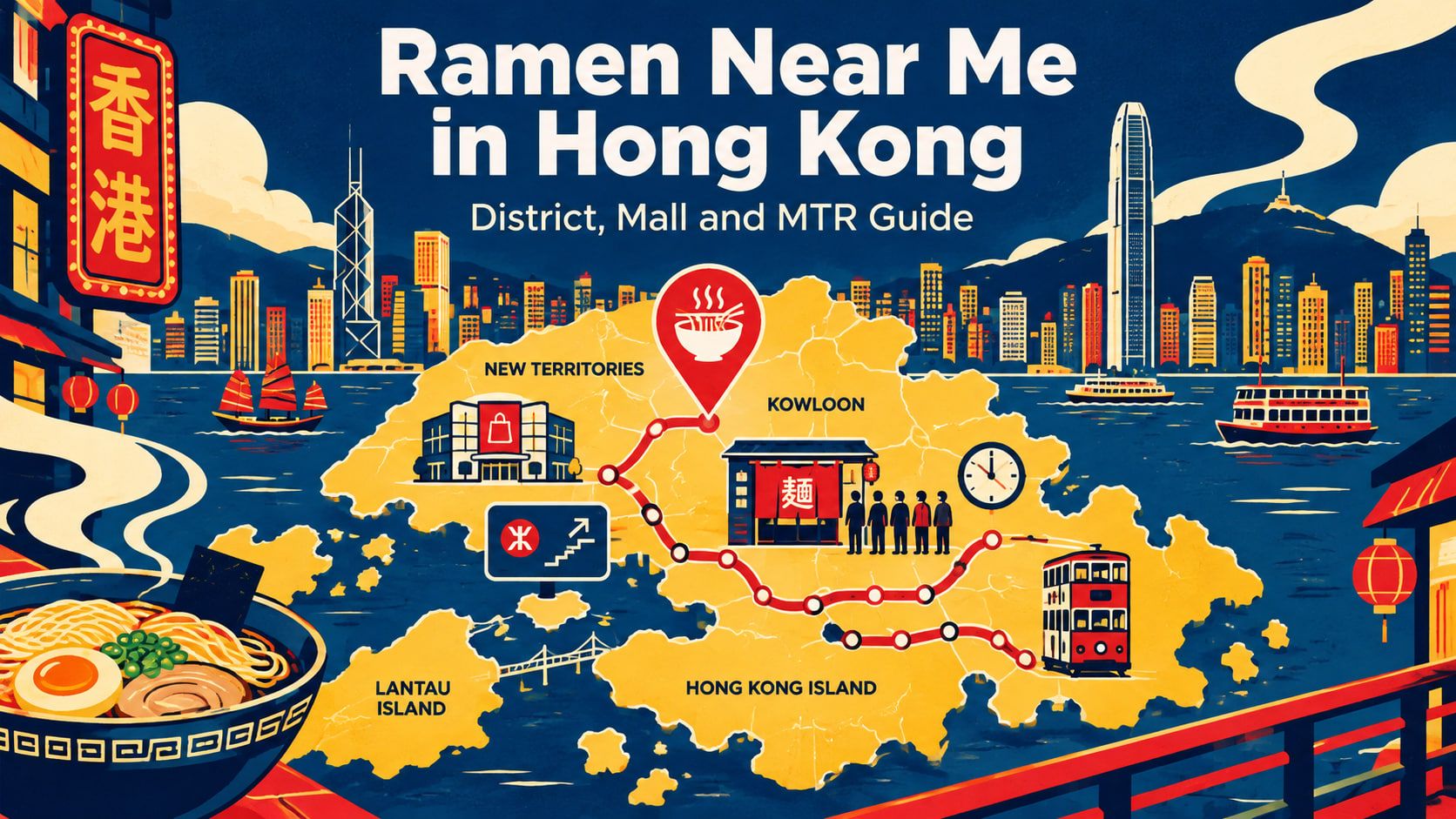
Use this location-first guide to choose an area, plan around an MTR exit and avoid arriving at a closed or over-queued ramen shop.

Understand why ramen is eaten fast, slurped loudly, ordered by ticket and discussed with Japanese vocabulary.
Plan ramen in Causeway Bay through location checks, MTR access and practical decisions about timing and queues.
Plan a Central ramen meal around your route, available time and the operator details to confirm before travelling.
Explore ramen in Wan Chai with area planning, MTR access and checks on menus, hours and queues.
Plan ramen in Tsim Sha Tsui through station access, branch verification and a workable fallback for your visit.
Explore Mong Kok ramen with attention to the actual address, building access, opening arrangements and waiting time.
Plan a Sheung Wan ramen visit by checking the location, menu and service window before walking over.
Find your next Kwun Tong ramen enquiry through local access, meal timing and operator verification.