
Ramen Franchise in Hong Kong: Fees, Control and Due Diligence
Evaluate a Hong Kong ramen franchise through fees, support, supply obligations and professional agreement review.
Ramen Franchises in Hong Kong: What a Franchise Does and Does Not Buy
A ramen franchise in Hong Kong buys a brand, a recipe system, supply arrangements and operating manuals; it does not buy a restaurant licence, a lease, exemption from labour law or a guaranteed return. Hong Kong has no specific franchise legislation, according to the Hong Kong Franchise Association, so a franchise agreement is governed by general contract law plus the Trade Descriptions Ordinance and intellectual-property legislation, and there is no statutory pre-contract disclosure requirement. The due diligence burden therefore sits with the prospective franchisee.
This page is for Hong Kong investors weighing a ramen franchise against an independent opening, and for operators approached by a Japanese or regional brand. It sits under opening a ramen shop in Hong Kong and should be read alongside ramen shop start-up costs. It explains the structure and the checks; it does not recommend any brand.
The compare-first rule. Price the franchise line by line against doing the same work yourself: recipe development, supplier sourcing, design, training, marketing and ongoing support. Then ask what the royalty buys each month after opening. If the answer is mainly the name, the name has to be worth it in your district.
📜 1. The legal framework
The Hong Kong Franchise Association states that there is no specific legislation governing franchising in Hong Kong, that disputes fall under common law and contract principles, and that relevant statutes include the Trade Marks Ordinance, Trade Descriptions Ordinance, Copyright Ordinance, Registered Designs Ordinance and Patents Ordinance. A 2022 legal review adds that there are no specific pre-contractual disclosure requirements, although the Association's Code of Ethics asks franchisors to provide full and accurate written disclosure within a reasonable time before signing. A 2026 dispute-resolution article notes that earnings claims can engage the Trade Descriptions Ordinance. In practice: read the agreement with a Hong Kong solicitor, because the contract is the law.
💵 2. What you typically pay
- Initial franchise fee: for the right to use the brand and system in a defined territory.
- Royalty: usually a percentage of gross sales, payable regardless of profit.
- Marketing fund contribution: a further percentage, with limited control over how it is spent.
- Mandatory purchases: noodles, tare, broth base or equipment from the franchisor or approved suppliers, often at a margin to the franchisor.
- Design and fit-out standards: which can raise the cost tier above an independent fit-out.
- Renewal and transfer fees: payable at the end of the term or on sale.
🔎 3. Questions to ask before signing
- Which cooking methods does the system require, and do they fit a Light Refreshment Restaurant Licence or demand a General Restaurant Licence? See restaurant licences in Hong Kong.
- Is broth made on site, at a commissary or imported? Imported meat-based products are subject to Centre for Food Safety import controls and need an importer with the right licences.
- Who sources noodles, and can you switch supplier if quality or price slips? See ramen suppliers in Hong Kong.
- What territory protection exists, and does it cover delivery platforms?
- What does ongoing support consist of, in hours and people, after opening?
- What are the exit terms: can you sell, and what happens to the fit-out and stock?
- Ask for the franchisor's existing Hong Kong franchisees' contact details and speak to them without the franchisor present.
📊 4. Earnings claims and what to do with them
Treat any projected turnover or margin from a franchisor as a claim to be tested, not a plan. Ask whether the figures come from company-owned or franchised outlets, in which districts, over what period, and whether they are gross or net of royalties and mandatory purchases. Rebuild them using your own rent from ramen shop rent in Hong Kong, your own labour costs including the HK$43.1 statutory minimum wage from May 2026 and 5% MPF, and the margin logic on ramen shop profit margins. A claim that cannot be rebuilt from your inputs is not usable.
🍜 5. Hong Kong brand context
Several Japanese ramen brands operate in Hong Kong through local companies, licensees or joint ventures rather than conventional unit franchising, and the structure differs by brand. The brand pages under ramen restaurants in Hong Kong describe what each operator publishes about itself, not their commercial arrangements. Do not infer that a brand is open to Hong Kong franchising from the fact that it has local branches; ask the brand's corporate office directly.
🧭 6. Franchise or independent
An independent keeps the royalty and controls the recipe, but carries the full cost and risk of developing a system and finding suppliers. A franchise can shorten the path for a first-time operator, at the price of ongoing fees and limited flexibility. Either way the licence, lease, works and labour obligations are identical. Set both options out in a ramen restaurant business plan and compare them on the same assumptions.
No disclosure law protects you. Because Hong Kong has no franchise-specific statute or mandatory disclosure regime, the agreement you sign defines your rights. Have a Hong Kong solicitor review it, verify every earnings claim independently, and do not pay a deposit or sign a lease on the strength of a franchisor's site recommendation before your own FEHD, Buildings Department and Fire Services Department checks. This page is general information, not legal advice.
❓ 7. FAQ
Is franchising regulated in Hong Kong? There is no specific franchise legislation. Agreements are governed by contract law, with the Trade Descriptions Ordinance and intellectual-property statutes relevant, according to the Hong Kong Franchise Association.
Does a franchise include the restaurant licence? No. The licence, lease, building and fire compliance remain the franchisee's responsibility.
Can I trust the franchisor's turnover projections? Treat them as claims to test. Rebuild them with your own rent, wages and purchase costs.
Can I franchise a famous Japanese ramen brand in Hong Kong? Many operate through local companies or licensees rather than unit franchising. Ask the brand's corporate office; do not assume.
Who should review the agreement? A Hong Kong solicitor with franchise or commercial contract experience.
how to open a ramen shop Hong Kong ramen shop startup cost ramen franchise Hong Kong ramen franchise cost ramen restaurant business plan restaurant licence Hong Kong ramen noodle machine ramen supplier Hong Kong ramen bowls wholesale Hong Kong ramen shop rent Hong Kong
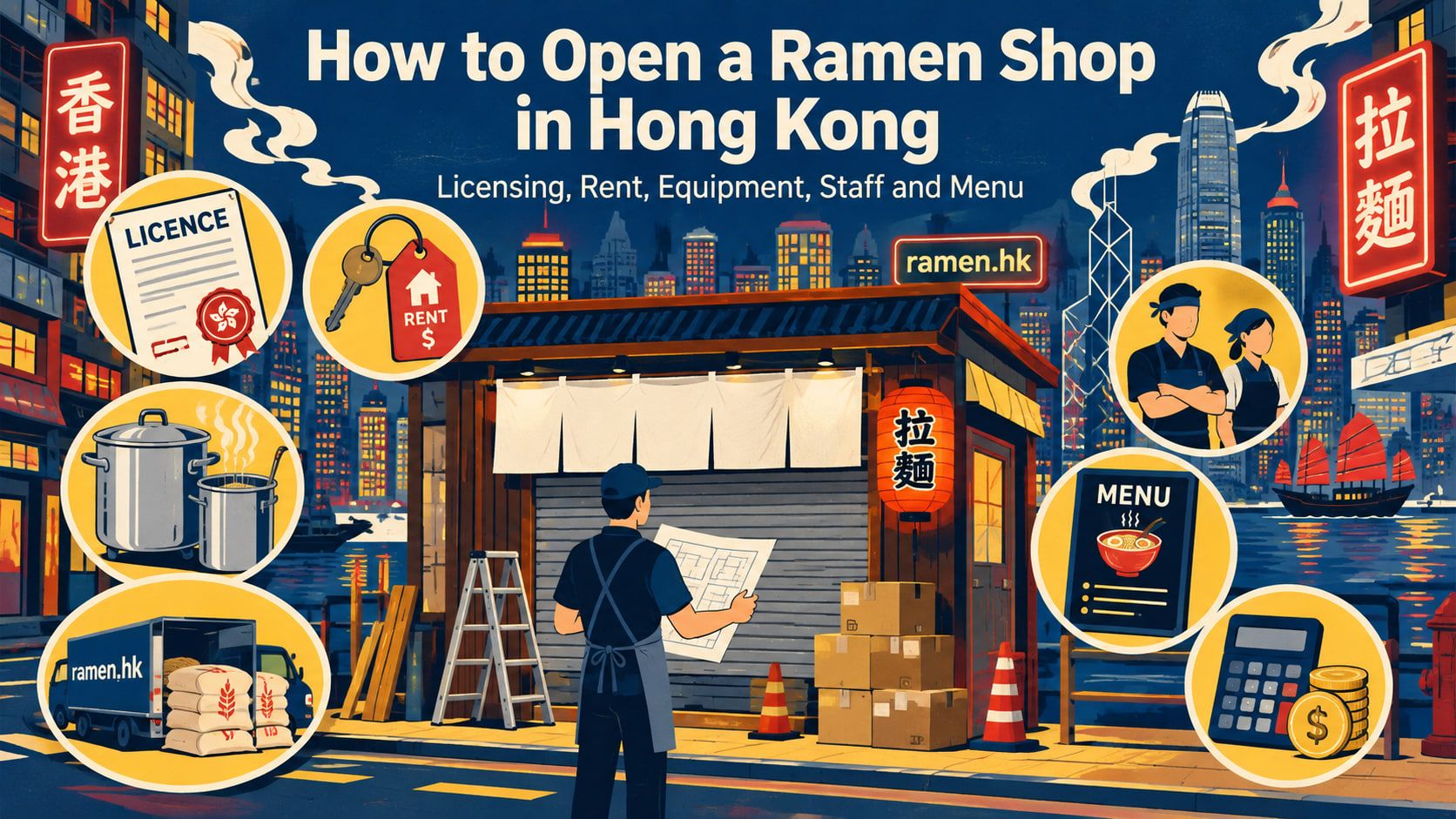
Plan a ramen business with licensing, rent, equipment, suppliers, staffing and menu decisions explained for Hong Kong reality.
Build ramen shop start-up costs from premises-specific quotes, licence needs, equipment and working-capital assumptions.
Understand Hong Kong restaurant licence options and premises checks before committing to a ramen shop lease.
Assess ramen shop rent through the actual lease, works, recurring charges and realistic seating and trading assumptions.
Build a Hong Kong ramen business plan with traceable costs, clear assumptions and tests for operational risk.
Assess a ramen noodle machine through model-specific space, power, training, maintenance and production needs.
Choose Hong Kong ramen suppliers through specifications, traceability, delivery terms and contingency supply.
Source wholesale ramen bowls through serving capacity, handling, cleaning suitability and replacement availability.
Model ramen shop margins through actual purchasing, staffing, occupancy and turnover assumptions rather than borrowed percentages.
Explore why ramen shops close through operational risks while avoiding speculation about any individual business’s finances.