
Ramen Shop Startup Cost in Hong Kong: Cost Tiers and Line Items
Build ramen shop start-up costs from premises-specific quotes, licence needs, equipment and working-capital assumptions.
Ramen Shop Start-up Costs in Hong Kong: Cost Tiers, Not Guesses
The start-up cost of a ramen shop in Hong Kong is driven by five variables that differ so much between sites that any single headline figure is misleading: rent and deposit, the licence route, kitchen ventilation and grease-trap works, fit-out, and the working capital to survive the licensing period. The practical rule is to cost the licence first, because a Light Refreshment Restaurant Licence restricts you to boiling, stewing, steaming, braising and simple frying with no large volume of greasy fumes, while a General Restaurant Licence permits any cooking method and usually demands heavier ventilation and fire-safety works. Noodle shops are listed by FEHD as a typical Light Refreshment Restaurant example, but a tonkotsu kitchen that sears chashu or stir-fries may not fit.
This page is for prospective Hong Kong operators building a first budget and for anyone sanity-checking a franchise or consultant's cost sheet. It sits under opening a ramen shop in Hong Kong. It uses cost tiers and official requirements rather than fixed totals, because the sources used do not support a reliable Hong Kong-wide figure.
The licence-before-lease rule. Do not sign a lease before confirming with FEHD, the Buildings Department and the Fire Services Department that the premises can be licensed for the cooking you intend. A deposit on an unlicensable unit is the most common avoidable loss.
🏢 1. Rent, deposit and premium
Retail rent is the largest fixed cost and varies by district, floor, frontage and whether the unit already has a licensed kitchen, exhaust duct and grease trap. The Rating and Valuation Department publishes private retail average rents and rental indices, which are the right baseline for district-level comparison; agent asking rents are not. Budget for a deposit of several months' rent, legal fees, stamp duty and possibly a key-money premium for a unit with an existing licence. The detailed trade-offs are on ramen shop rent in Hong Kong.
📜 2. Licensing route and timeline
FEHD requires a restaurant licence for selling meals for consumption on the premises, applied for on form FEHB 94 with three copies of layout plans at a scale of not less than 1:100. Licensing depends on compliance with Buildings Department requirements, including freedom from unauthorised building works, Fire Services Department requirements including mechanical ventilation, government lease conditions and statutory plan restrictions. FEHD operates a provisional licence valid for six months, issued over the counter within one working day once an authorised person, a registered ventilation contractor and a registered fire service installation contractor certify compliance with the essential requirements. Professional certification fees, plan drawing and any remedial works are real costs; the process is explained on restaurant licences in Hong Kong.
🔧 3. Kitchen works that swing the budget
- Exhaust and ventilation: the single biggest variable. A unit with an existing compliant duct to roof level is in a different cost tier from one that needs a new riser or landlord consent for external works.
- Grease trap: FEHD requires effective grease interception; installation and the ongoing cleaning contract both cost money.
- Fire services: sprinkler, alarm and extinguisher works certified by a registered contractor.
- Gas versus induction: town gas supply and a gas-safety certificate versus heavy-duty induction for stock pots, which shifts cost from installation to electricity load and may need a power upgrade.
- Drainage and water: stock pots and noodle boilers generate hot waste water; floor drains and water heating are often underestimated.
- Noodle production: an in-house machine, a commissary or a supplier contract; see ramen noodle machines.
🪑 4. Fit-out, equipment and tableware
Counter seating keeps square footage and staffing down, which is why many Hong Kong ramen shops run 12 to 25 seats. Second-hand stainless equipment, leased point-of-sale systems and a ticket machine are all ways to shift cost tiers. Bowls, trays, chopsticks and spoons need a replacement budget as well as an opening order; see wholesale ramen bowls in Hong Kong. Supplier deposits and first stock orders are covered on ramen suppliers in Hong Kong.
💵 5. Working capital and the first months
Budget for rent, wages and MPF, utilities and ingredient purchases for the months between signing the lease and trading at a stable level, plus the licensing period itself. The Census and Statistics Department's provisional figures for the second quarter of 2026 show total restaurant receipts of HK$27.2 billion, up 0.4% year on year, while purchases rose 2.5% to HK$8.8 billion; input costs rising faster than receipts is the sector context a new operator inherits. Employer obligations, including the HK$43.1 statutory minimum wage from May 2026 and 5% MPF contributions, are on restaurant labour rights in Hong Kong. Margin assumptions are tested on ramen shop profit margins.
🧮 6. Building the budget
- List the cooking methods your menu needs and confirm the licence type with FEHD before viewing units.
- Shortlist units by existing licence, exhaust and grease-trap condition, and check for unauthorised building works.
- Obtain quotes from an authorised person, a ventilation contractor and a fire services contractor for the specific unit.
- Price the kitchen in tiers: existing-compliant, partial-works, full-works.
- Add fit-out, equipment, tableware, first stock and deposits.
- Add working capital for at least the licensing period plus a trading ramp-up, then stress-test with a lower seat turnover than you hope for.
- Decide whether a franchise fee buys enough of this work to be worth it; see ramen franchises in Hong Kong and assemble it all in a ramen restaurant business plan.
Fixed price figures require current sourced evidence. Any consultant, franchisor or article that quotes a single Hong Kong ramen start-up total without the unit's licence status, exhaust condition and district rent is guessing. Verify every cost against a written quote for your specific premises, and treat the licensing requirements summarised here as a starting point for reading FEHD's current guide, not a substitute for it.
❓ 7. FAQ
How much does it cost to open a ramen shop in Hong Kong? There is no reliable single figure. Costs depend on rent, licence type, ventilation and fire works, fit-out and working capital, which vary by unit. Budget in tiers using written quotes.
Can a ramen shop use a Light Refreshment Restaurant Licence? FEHD lists noodle shops as a typical example, but the licence limits cooking to boiling, stewing, steaming, braising and simple frying without large greasy fumes. Confirm your menu's methods with FEHD.
How long does licensing take? A provisional licence can be issued within one working day once professionals certify essential compliance, and is valid for six months. Reaching that point depends on the works required.
What is the biggest hidden cost? Usually exhaust and ventilation works, followed by remedial building and fire-safety work on an older unit.
Is a franchise cheaper? Not necessarily. A franchise fee may cover design and supply chain but rarely removes licensing, rent or works costs. Compare line by line.
how to open a ramen shop Hong Kong ramen shop startup cost ramen franchise Hong Kong ramen franchise cost ramen restaurant business plan restaurant licence Hong Kong ramen noodle machine ramen supplier Hong Kong ramen bowls wholesale Hong Kong ramen shop rent Hong Kong
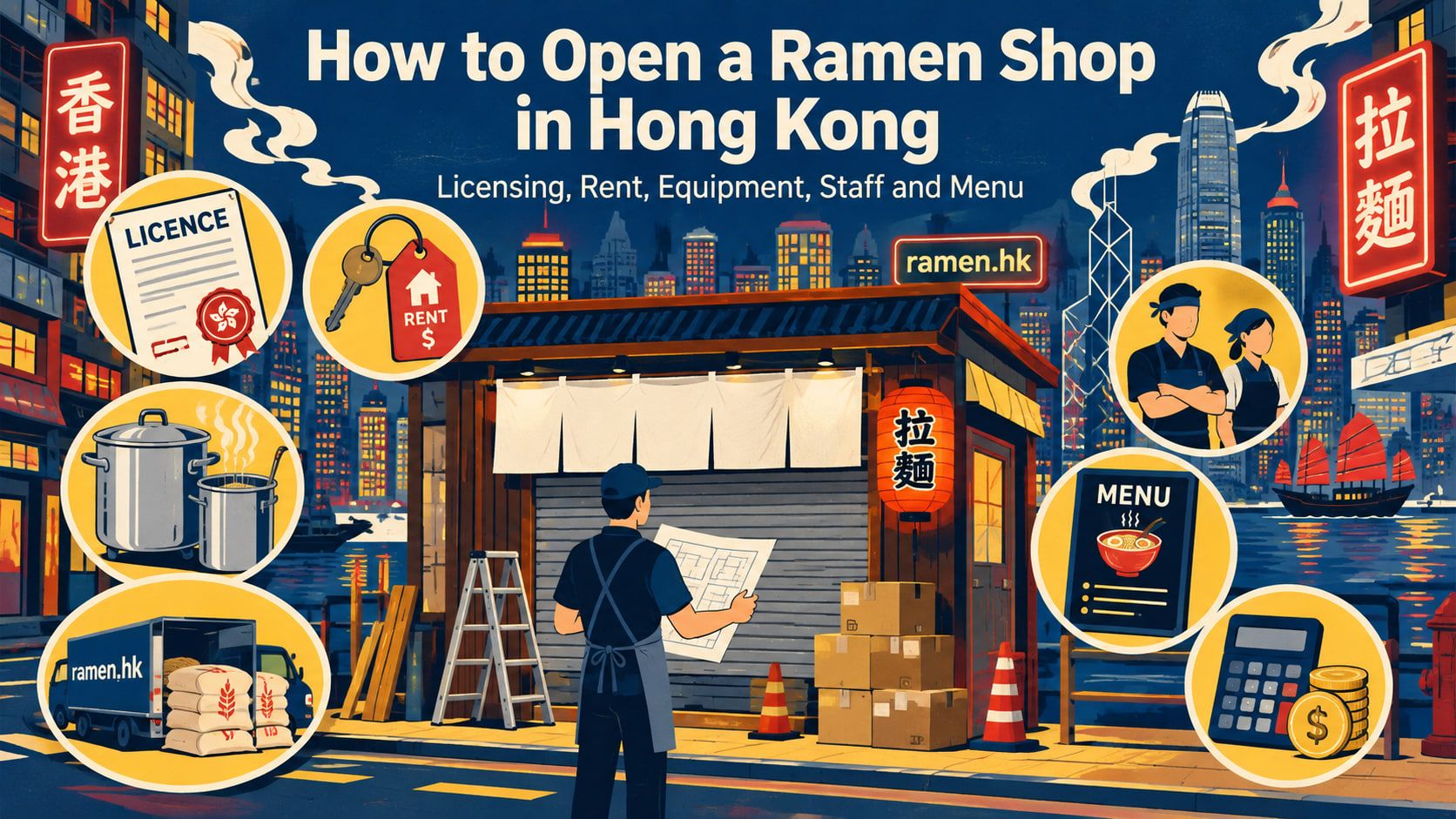
Plan a ramen business with licensing, rent, equipment, suppliers, staffing and menu decisions explained for Hong Kong reality.
Understand Hong Kong restaurant licence options and premises checks before committing to a ramen shop lease.
Assess ramen shop rent through the actual lease, works, recurring charges and realistic seating and trading assumptions.
Evaluate a Hong Kong ramen franchise through fees, support, supply obligations and professional agreement review.
Build a Hong Kong ramen business plan with traceable costs, clear assumptions and tests for operational risk.
Assess a ramen noodle machine through model-specific space, power, training, maintenance and production needs.
Choose Hong Kong ramen suppliers through specifications, traceability, delivery terms and contingency supply.
Source wholesale ramen bowls through serving capacity, handling, cleaning suitability and replacement availability.
Model ramen shop margins through actual purchasing, staffing, occupancy and turnover assumptions rather than borrowed percentages.
Explore why ramen shops close through operational risks while avoiding speculation about any individual business’s finances.