
Ramen Restaurant Business Plan: Hong Kong Template and Assumptions
Build a Hong Kong ramen business plan with traceable costs, clear assumptions and tests for operational risk.
Ramen Restaurant Business Plan: A Hong Kong Template Without Invented Numbers
A ramen restaurant business plan for Hong Kong is a document that ties a menu to a licence type, a licence type to a unit, a unit to a rent, and a rent to the number of bowls each seat must sell, with every figure traceable to a quote, an official statistic or a stated assumption. The practical rule is that every number in the plan must carry a source or be labelled an assumption with a range, because landlords, banks and partners in Hong Kong will test the rent, licence and labour lines first. A plan built on borrowed averages fails that test.
This page is for first-time Hong Kong operators, partners evaluating a proposal and anyone converting a franchise pitch into their own figures. It sits under opening a ramen shop in Hong Kong and draws together the cost, licence, rent and margin pages beneath that hub. It is a structure, not a template with pre-filled prices.
The one-line answer. Write the plan backwards from the licence: menu and cooking methods, then licence type, then qualifying units, then rent and works, then seats and turnover, then margins. If any link in that chain is unverified, the plan is not ready to fund.
🍜 1. Concept and menu
State the style, price tier and service format. A single-style counter, such as tonkotsu or shoyu, simplifies purchasing and training; a broad menu raises complexity and may push the kitchen from a Light Refreshment Restaurant Licence into a General Restaurant Licence because of frying or searing. Reference the style definitions on ramen types and decide whether noodles are made in house, bought from a supplier or produced at a commissary; the equipment implications are on ramen noodle machines.
📜 2. Licence, premises and compliance
- Licence type: General or Light Refreshment, matched to cooking methods, with FEHD's wording quoted; see restaurant licences in Hong Kong.
- Premises: unit status on FEHD's licensed-restaurant open data, exhaust route, grease trap, Buildings Department and Fire Services Department position, lease conditions and zoning.
- Timeline: provisional licence within one working day of professional certification, valid six months, then full licence; works lead time before that.
- Professionals: authorised person, ventilation contractor and fire services contractor named with quotes.
- Rent and lease: baseline from the Rating and Valuation Department, achieved comparables, deposit, rent-free period, reinstatement; see ramen shop rent in Hong Kong.
💵 3. Capital budget in tiers
Present the start-up budget as three tiers for the same unit: existing-compliant kitchen, partial works and full works, each with written quotes attached. Include fit-out, equipment, tableware from wholesale ramen bowls in Hong Kong, first stock, deposits, professional fees, licence fees from FEHD's current schedule, and working capital for the licensing period plus a ramp-up. The structure is explained on ramen shop start-up costs. If a franchise is involved, show its fees as a separate column against the independent route; see ramen franchises in Hong Kong.
👥 4. Staffing and labour cost
List roles by shift: broth and prep, noodle and assembly, floor and wash, with hours per week. Cost them at the rates you will actually pay, not below the HK$43.1 statutory minimum wage in force from 1 May 2026, plus 5% employer MPF, meals, rest days and statutory holidays including Easter Monday from 2026. Show how the roster covers split shifts and late closes. Employer obligations are summarised on restaurant labour rights in Hong Kong, and realistic duties on working at a ramen shop.
📊 5. Revenue model and sensitivity
- Seats multiplied by realistic turns per service, by trading days, by average spend at your price tier, with lunch and dinner modelled separately.
- Delivery and takeaway as a separate line with platform commission deducted.
- Cost of goods per bowl built from supplier quotes on ramen suppliers in Hong Kong, not from a borrowed percentage.
- Fixed costs: rent, management fees, rates, utilities, insurance, licence renewals, grease-trap cleaning, royalties if any.
- Sensitivity: show the plan at 70%, 85% and 100% of target turnover and at purchase costs 5% and 10% higher; the Census and Statistics Department's provisional second-quarter 2026 figures showed restaurant purchases rising 2.5% while receipts rose 0.4%.
- Break-even bowls per day per seat, which is the number a partner will ask for; margin logic is on ramen shop profit margins.
🧭 6. Risks and exit
State the risks plainly: licence refusal or delay, exhaust works cost overrun, rent review, staff shortage, typhoon closures, platform commission changes and the possibility that the concept does not draw queues. A third-party analysis citing FEHD data counted more than 2,000 restaurant closures in Hong Kong in the year to April 2026 against 1,779 openings; the causes are discussed on why ramen shops close in Hong Kong. Include an exit section covering lease break clauses, reinstatement cost and resale of equipment, so that the downside is costed as carefully as the upside.
Fixed price figures require current sourced evidence. Do not fill this structure with rents, wages, margins or start-up totals copied from articles, forums or franchise decks. Every figure should come from a written quote for your unit, an official statistic with a date, or a labelled assumption with a range. A plan that cannot show its sources will not survive a landlord's, bank's or partner's questions.
❓ 7. FAQ
How long should a ramen business plan be? Long enough to trace every figure to a source. A clear 15-page plan with attached quotes is more credible than 50 pages of narrative.
What do investors check first? Usually the licence feasibility of the unit, the rent as a share of projected receipts, and the labour cost at legal rates.
Should I include a franchise option? If you are considering one, show it as a parallel column against the independent route on identical assumptions.
Where do official Hong Kong figures come from? FEHD for licensing, the Rating and Valuation Department for rents, the Labour Department and MPFA for labour costs, and the Census and Statistics Department for sector receipts.
What is the most common mistake? Signing a lease before confirming the licence route, then discovering that the exhaust or fire-safety works cost more than the budget.
how to open a ramen shop Hong Kong ramen shop startup cost ramen franchise Hong Kong ramen franchise cost ramen restaurant business plan restaurant licence Hong Kong ramen noodle machine ramen supplier Hong Kong ramen bowls wholesale Hong Kong ramen shop rent Hong Kong
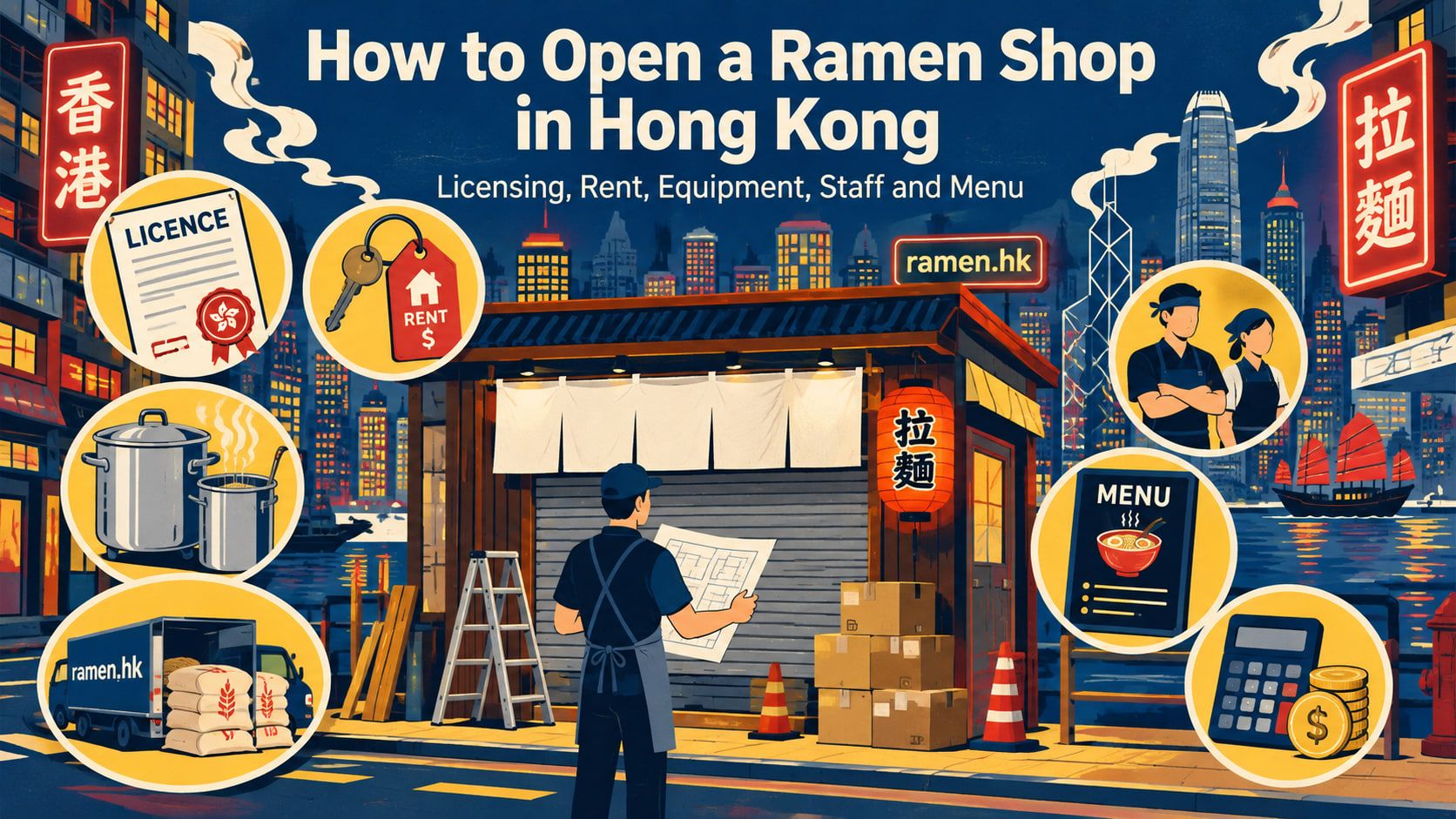
Plan a ramen business with licensing, rent, equipment, suppliers, staffing and menu decisions explained for Hong Kong reality.
Build ramen shop start-up costs from premises-specific quotes, licence needs, equipment and working-capital assumptions.
Understand Hong Kong restaurant licence options and premises checks before committing to a ramen shop lease.
Assess ramen shop rent through the actual lease, works, recurring charges and realistic seating and trading assumptions.
Evaluate a Hong Kong ramen franchise through fees, support, supply obligations and professional agreement review.
Assess a ramen noodle machine through model-specific space, power, training, maintenance and production needs.
Choose Hong Kong ramen suppliers through specifications, traceability, delivery terms and contingency supply.
Source wholesale ramen bowls through serving capacity, handling, cleaning suitability and replacement availability.
Model ramen shop margins through actual purchasing, staffing, occupancy and turnover assumptions rather than borrowed percentages.
Explore why ramen shops close through operational risks while avoiding speculation about any individual business’s finances.