Restaurant Licence in Hong Kong: What a Ramen Shop Needs
Understand Hong Kong restaurant licence options and premises checks before committing to a ramen shop lease.
Restaurant Licences in Hong Kong: What a Ramen Shop Needs
A ramen shop selling bowls for consumption on the premises needs a restaurant licence from the Food and Environmental Hygiene Department, and the first decision is between a General Restaurant Licence and a Light Refreshment Restaurant Licence. FEHD states that a General Restaurant Licence permits any kind of cooking method, while a Light Refreshment Restaurant Licence allows only simple methods such as boiling, stewing, steaming, braising and simple frying, excluding deep frying and stir frying, that do not generate a large amount of greasy fumes. Hot pot, teppanyaki and other cooking in the seating area are permitted only under the general licence.
This page is for prospective Hong Kong ramen operators and for tenants trying to understand what a landlord means by 'licensed premises'. It sits under opening a ramen shop in Hong Kong and feeds directly into ramen shop start-up costs. It summarises FEHD's published guidance and is not legal advice.
The licence rule. Match the licence to the menu before anything else. A ramen kitchen that simmers broth and boils noodles may fit a Light Refreshment Restaurant Licence; one that sears or torches chashu, deep-fries karaage or stir-fries toppings in a wok is generating the greasy fumes that FEHD's wording excludes.
📜 1. The two licence types
- General Restaurant Licence: any cooking method; cooking or reheating in the seating area allowed; typically heavier ventilation and fire-safety requirements. FEHD's examples include Chinese restaurants, steakhouses and hot-pot restaurants.
- Light Refreshment Restaurant Licence: boiling, stewing, steaming, braising and simple frying only, excluding deep frying and stir frying, with no large volume of greasy fumes. FEHD's examples include congee shops, noodle shops and coffee shops.
- A third type, the Marine Restaurant Licence, applies only to vessels.
- The licence is required for selling meals or unbottled non-alcoholic drinks for consumption on the premises; factory canteens and licensed hawkers are excluded.
📝 2. The application
The application is made on form FEHB 94 to the relevant FEHD licensing office in person, by post or online, in the name of a person or a corporation, with three copies of proposed layout plans drawn to scale at not less than 1:100 in metric units. Plans must show the food room, seating area, toilets, passageways, door swings, equipment and finishes, including any in-house noodle production equipment described on ramen noodle machines. FEHD then issues a letter of requirements covering health, building, fire and ventilation matters. The quick reference guide lists compliance with Buildings Department requirements including freedom from unauthorised building works, Fire Services Department requirements including mechanical ventilation, government lease conditions and statutory plan restrictions as the main hurdles.
⏱️ 3. The provisional licence
FEHD operates a provisional licensing system so that a shop can open while completing non-essential requirements. The application is optional and must be made at the same time as the full licence application. Once an authorised person registered under the Buildings Ordinance, a registered specialist ventilation contractor and a registered fire service installation contractor certify that the essential health, building, fire and ventilation requirements are met, FEHD can issue a provisional licence over the counter within one working day. It is valid for six months, during which the remaining requirements must be completed for the full licence.
🏗️ 4. The other departments involved
- Buildings Department: structural suitability, means of escape, and no unauthorised building works. An authorised person's input is needed for plans and certification.
- Fire Services Department: fire service installations and the mechanical ventilating system; a registered fire service installation contractor certifies the works. FEHD's guide also refers to Registered Fire Engineers for risk assessment.
- Lands Department and planning: the government lease and the statutory outline zoning plan must permit restaurant use at the premises.
- Other permits: a liquor licence from the Liquor Licensing Board if you serve alcohol, and business registration with the Inland Revenue Department.
🧾 5. Fees, renewals and changes
FEHD publishes a fee schedule for restaurant licences; check it directly rather than relying on summaries, because fees are revised. A 2023 government press release noted that online renewal was introduced for some food licences but excluded General Restaurant, Light Refreshment Restaurant and Factory Canteen licences at that time; confirm the current renewal route with FEHD. Changing the licence type, layout or cooking equipment after issue generally requires a fresh application or approval. If a franchisor specifies cooking methods, confirm they fit the licence before signing; see ramen franchises in Hong Kong.
🔎 6. Checking a unit before you sign
- Search the FEHD licensed-restaurant list, published as open data, to see whether the unit holds a current licence and of which type.
- Ask the landlord for the licence, approved layout plans and any Buildings Department orders.
- Walk the exhaust route from kitchen to discharge point and check the grease trap exists and is accessible.
- Commission an authorised person to review before paying a deposit.
- Record the licence route, works and timeline in the business plan, then compare the result with your menu's cooking methods and with the rent on ramen shop rent in Hong Kong.
Do not sign a lease before licence checks. Landlords and agents may describe a unit as 'with licence' when the licence is a Light Refreshment Restaurant Licence, has lapsed, or is tied to a layout you intend to change. FEHD's requirements summarised here are current as of October 2026 but are revised; read FEHD's own guide and consult an authorised person before committing money. This page is general information, not legal advice.
❓ 7. FAQ
Which licence does a ramen shop need? It depends on cooking methods. Simmering and boiling may fit a Light Refreshment Restaurant Licence; deep frying, stir frying or heavy searing point to a General Restaurant Licence. Confirm with FEHD.
How quickly can I open? A provisional licence can be issued within one working day once professionals certify essential compliance, and lasts six months. The works needed to reach that point set the real timeline.
What form do I use? FEHB 94, with three copies of layout plans at not less than 1:100 scale, per FEHD's guide.
Can I cook at the table under a light refreshment licence? No. FEHD states cooking or reheating in the seating area is allowed only under a General Restaurant Licence.
Where can I check whether a unit is licensed? FEHD publishes the list of licensed restaurants as open data on data.gov.hk.
how to open a ramen shop Hong Kong ramen shop startup cost ramen franchise Hong Kong ramen franchise cost ramen restaurant business plan restaurant licence Hong Kong ramen noodle machine ramen supplier Hong Kong ramen bowls wholesale Hong Kong ramen shop rent Hong Kong
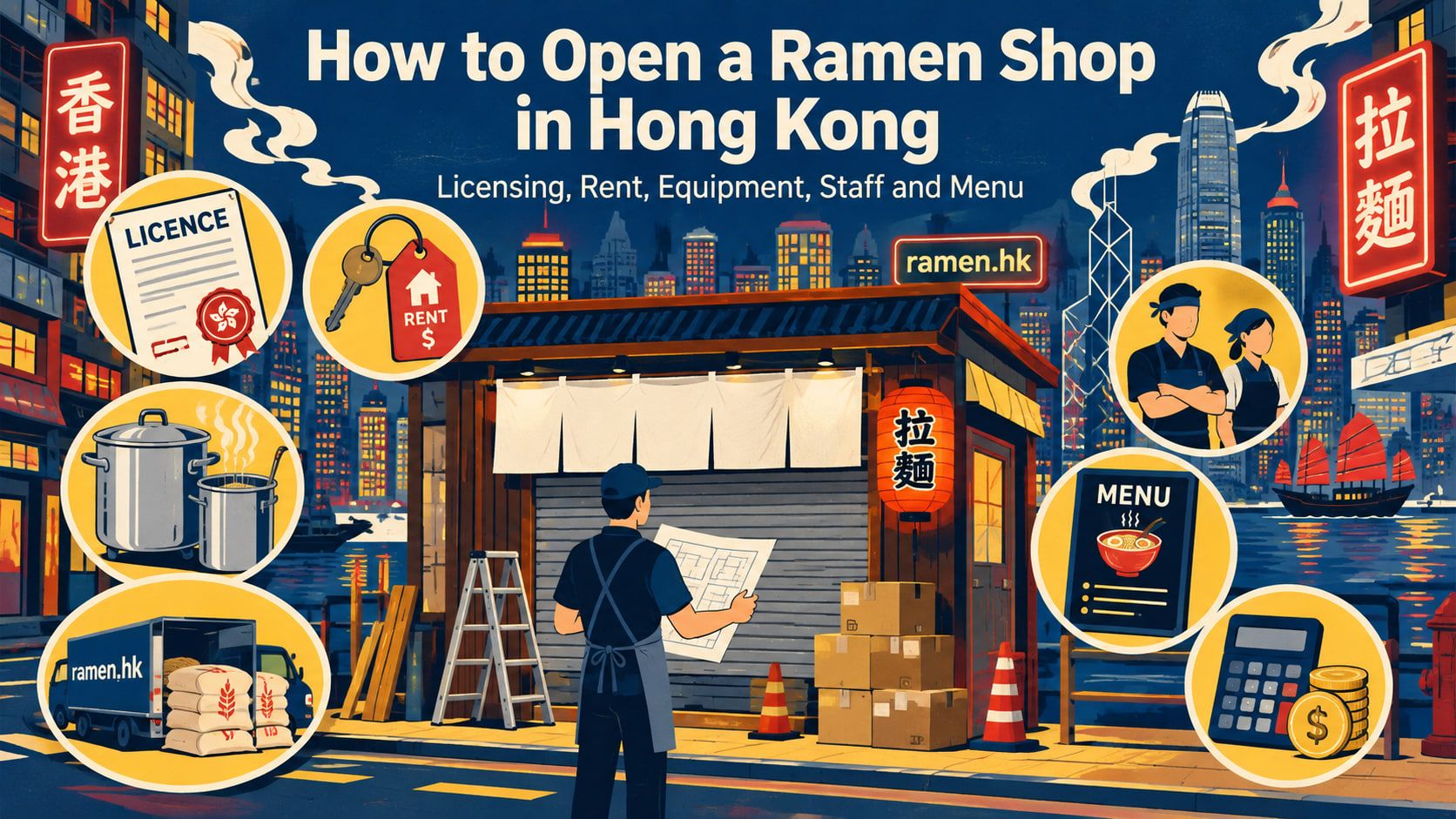
Plan a ramen business with licensing, rent, equipment, suppliers, staffing and menu decisions explained for Hong Kong reality.
Build ramen shop start-up costs from premises-specific quotes, licence needs, equipment and working-capital assumptions.
Assess ramen shop rent through the actual lease, works, recurring charges and realistic seating and trading assumptions.
Evaluate a Hong Kong ramen franchise through fees, support, supply obligations and professional agreement review.
Build a Hong Kong ramen business plan with traceable costs, clear assumptions and tests for operational risk.
Assess a ramen noodle machine through model-specific space, power, training, maintenance and production needs.
Choose Hong Kong ramen suppliers through specifications, traceability, delivery terms and contingency supply.
Source wholesale ramen bowls through serving capacity, handling, cleaning suitability and replacement availability.
Model ramen shop margins through actual purchasing, staffing, occupancy and turnover assumptions rather than borrowed percentages.
Explore why ramen shops close through operational risks while avoiding speculation about any individual business’s finances.