
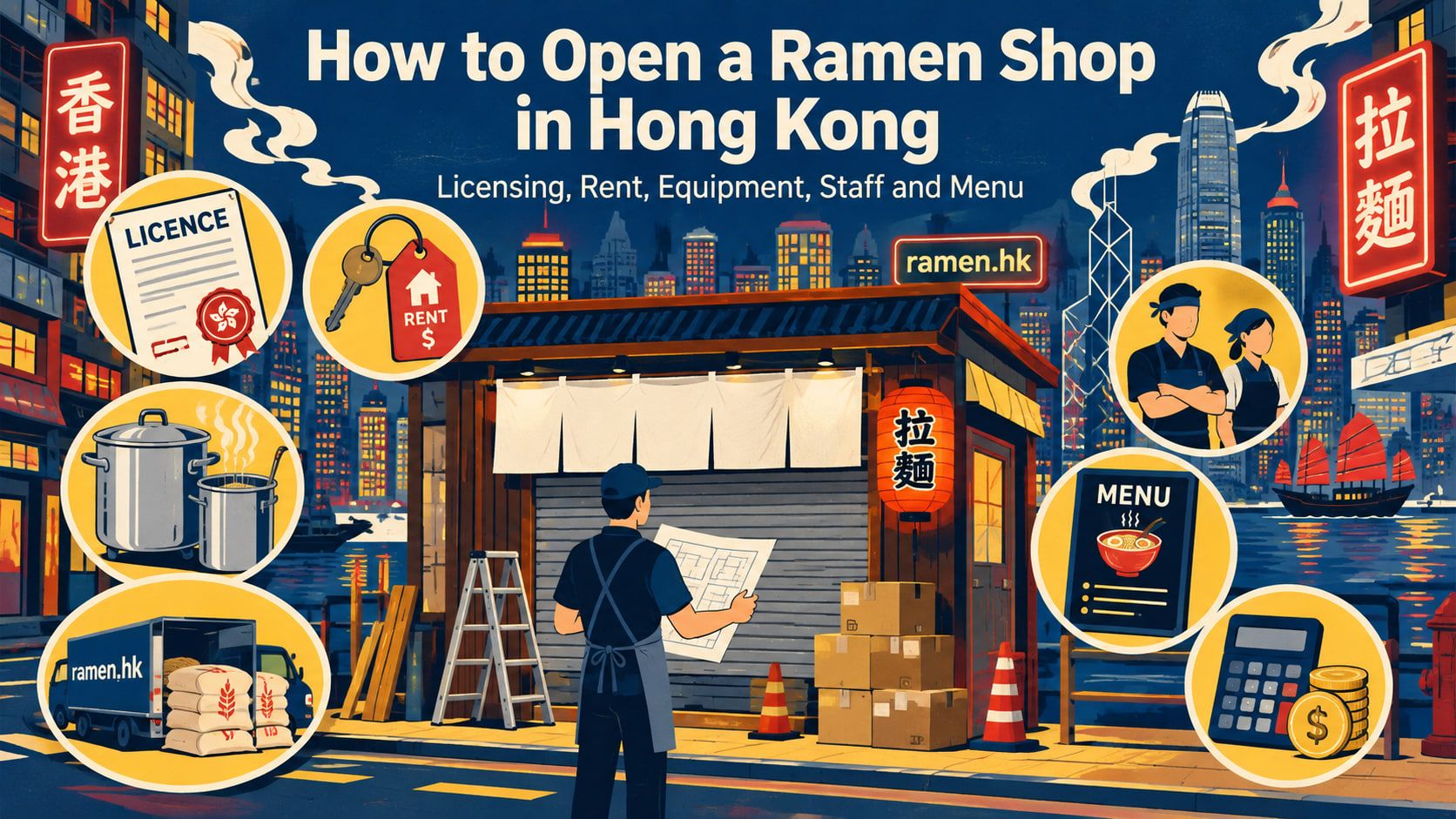
How to Open a Ramen Shop in Hong Kong
Plan a ramen business with licensing, rent, equipment, suppliers, staffing and menu decisions explained for Hong Kong reality.
Open a Ramen Shop in Hong Kong: Licences, Premises, Costs, Suppliers and Staffing
Plan a ramen business around a licensable premises and a workable menu before committing to rent or fit-out.
Highlight key: premises and licensing · costs and cash flow · practical actions · legal and commercial risks
The most important early decision is not the logo or the opening date: it is whether a specific unit can lawfully support your menu and cooking methods. List the dishes and production steps first, then check the premises, licence type, ventilation, fire safety and building requirements before signing a lease or starting works.
This hub organises the Hong Kong ramen-shop questions: licensing, premises, start-up costs, suppliers, equipment, staffing and commercial risk. It links to focused Ramen.hk guides and official sources. It is not legal, financial or engineering advice, and it does not promise approval, opening dates or profits.
Before you sign anything:
1. Write the menu and cooking methods.
2. Decide whether you need a General Restaurant Licence or whether a Light Refreshment Restaurant Licence could fit.
3. Check the unit’s lease conditions, occupation permit, statutory plan and building records.
4. Ask qualified professionals about ventilation, fire safety, gas, electrical and building works.
5. Model rent and staff costs during licensing delays.
6. Do not fit out before FEHD’s Letter of Requirements, and do not trade before obtaining a licence.
📋 1. Match the menu and cooking methods to the licence
FEHD says that, for Light Refreshment Restaurant applications made on or after 1 March 2023, food items are no longer restricted to the old specified groups. Instead, LRRs may use only simple cooking methods that do not generate large amounts of greasy fumes.
| Licence | Cooking position | Planning implication |
|---|---|---|
| Light Refreshment Restaurant Licence | Simple methods such as boiling, stewing, steaming, braising and simple frying; deep frying and stir frying excluded. No cooking or reheating in the seating area. | Check every broth, topping and side-dish method against the restriction before relying on this route. |
| General Restaurant Licence | Greater flexibility in food preparation than an LRR. | FEHD also requires specified kitchens and a higher food-room-to-floor-area ratio than an LRR. |
Calling the business a “noodle shop” does not settle the licence type. A ramen menu including fried karaage, gyoza or stir-fried toppings needs specific review. If you plan to sell restricted foods such as sashimi or sushi, FEHD requires written permission; indicate this in the application.
Continue with Hong Kong restaurant licensing. To map dishes to production steps, use ramen components and ramen styles.
🏢 2. Check the premises before signing the lease
FEHD’s Guide to Application for Restaurant Licences (November 2025 edition) asks applicants to check that restaurant use complies with the Government lease, Occupation Permit and statutory plan, and to review approved building records for unauthorised building works.
Useful early signs
- FEHD prefers net floor area of at least 30 m² for a general restaurant and 20 m² for a light refreshment restaurant.
- The unit should have mains water, flushed toilets and proper drainage.
- It should be capable of providing separate, independent ventilation to the kitchen, toilets and seating area.
- Floors need adequate loading capacity; FEHD’s guide gives a minimum designed loading of 4 kPa for restaurants.
- Means of escape and fire safety must suit the proposed occupancy.
Warning signs in FEHD’s guide
- Premises in industrial or warehouse buildings.
- Upper floors designed for domestic use, or upper floors of single-staircase buildings.
- Premises at or below basement level four, or in emergency-use areas.
- Premises vertically below a registered school, child-care centre, elderly home or certain residential-care facilities.
- Kitchens or food rooms located where manholes or drainage pipes are present.
- Unauthorised building works that affect suitability.
A former restaurant use or existing licence is not automatic approval for your changed menu, layout or operator. FEHD processes a new application where a valid licence exists, but issues the new licence only after the existing one is cancelled.
🧾 3. Understand the licensing process
- Submit the application form, three copies of a scaled layout plan and, for private buildings, the lease-compliance self-declaration.
- FEHD screens the plan and refers it to Buildings Department and Fire Services Department as part of its one-stop process.
- FEHD aims to arrange an Application Vetting Panel meeting within 20 working days of accepting the application for further processing.
- If the premises are suitable, FEHD issues a Letter of Requirements.
- You complete works and submit compliance documents for a provisional and/or full licence.
FEHD advises applicants not to start fitting out before receiving the Letter of Requirements, and not to operate without a provisional or full licence. Performance pledges apply to individual processing steps; they are not a guaranteed total timeline from lease signing to opening.
A provisional licence is optional, must be applied for with a full licence, and FEHD states that it is valid for six months. It allows provisional operation pending a full licence, not unlimited delay in meeting requirements.
Official enquiry point: FEHD’s Restaurant Licensing Resource Centre, 4/F, Pei Ho Street Municipal Services Building, 333 Ki Lung Street, Sham Shui Po. Hotline: +852 2958 0694. Online tracking is available through Licence Application Tracking Facility after FEHD issues login details.
💰 4. Build costs from the unit and quotes, not a copied total
Use three scenarios: an existing layout requiring limited changes, moderate works, and substantial works. For each, attach a landlord proposal, written quote or clearly labelled assumption.
| Cost area | What to obtain or model |
|---|---|
| Lease | Deposit, rent, management fees, rent-free period, reinstatement terms and landlord consent for works. |
| Professional services | AP or RSE where required; ventilation, fire-service, gas and electrical contractors. |
| Works | Ventilation and exhaust, drainage, fire services, gas, electrical capacity, finishes and accessible facilities. |
| Pre-opening cash | Rent and staff costs during licensing delays, trial batches, packaging, initial stock and contingency. |
A lower rent is not necessarily cheaper if the unit needs a new exhaust route or major fire-safety work. Read start-up cost tiers, rent analysis and the business-plan guide.
🍜 5. Decide the production system before buying equipment
Decide which components you will make, buy or produce elsewhere: noodles, broth, tare, aroma oil and toppings. That choice affects space, equipment, staffing, food-safety controls and supplier risk.
- Equipment: obtain written dimensions, power and fuel needs, maintenance arrangements, spare-part access and training.
- Suppliers: compare like-for-like specifications, minimum orders, delivery days, storage conditions, traceability and backup supply.
- Fuel: FEHD notes that gas installation work must be carried out by a registered gas contractor, and cylinder LPG must come from an approved distributor.
- Tableware: choose capacity, weight, durability, washing method and replacement availability—not only appearance.
Focused guides: noodle machines · ramen suppliers · wholesale bowls.
👥 6. Staff the actual workload, including opening and closing
Plan for preparation, cooking, service, cashiering, cleaning, deliveries and closing tasks, not only peak service. A counter layout, ticket system and menu complexity can change staffing needs, but no universal ratio applies to every shop.
Employers must check current employment, MPF and work-permission obligations. From 18 January 2026, the Labour Department’s continuous-contract test uses at least 17 hours each week, or the specified four-week 68-hour alternative, together with four weeks’ continuous employment. Casual catering MPF arrangements have special rules.
Read ramen jobs and careers, working at a ramen shop and restaurant labour rights.
📉 7. Test risk rather than chasing an illustrative margin
Model lower sales, higher ingredient costs, longer licensing time, equipment failure and staff gaps. Keep sales assumptions separate from quotes, official requirements and actual operating data.
A competitor’s queue does not establish your revenue, and a franchise does not remove premises, licensing or employment obligations. Check exit, assignment and reinstatement terms before committing capital.
Focused guides: profit-margin modelling · franchise checks · why ramen shops close · price trends.
❓ 8. FAQ and sources
Can a ramen shop use a Light Refreshment Restaurant Licence?
It may, if the proposed operation and cooking methods fit FEHD’s LRR restrictions and the premises qualify. Deep frying and stir frying are excluded from the post-March 2023 LRR cooking methods.
Can I renovate while the application is being processed?
FEHD advises waiting for the Letter of Requirements before fitting out to avoid unnecessary loss.
Is business registration enough to open?
No. A restaurant requires the appropriate licence before operating, and other departments’ requirements still apply.
Is a provisional licence automatic?
No. It is optional, must be applied for alongside a full licence, and requires compliance with the relevant provisional licensing requirements.
Licensing details are based on FEHD’s LRR reform page and its November 2025 restaurant-licence guide. This hub provides general planning information, not legal, financial, architectural, engineering or licensing advice. Requirements depend on the specific premises, menu and current law; confirm with FEHD, relevant departments and qualified professionals before committing money.
"