
Ramen Shop Profit Margins: Food Cost, Labour and Rent
Model ramen shop margins through actual purchasing, staffing, occupancy and turnover assumptions rather than borrowed percentages.
Ramen Shop Profit Margins: How to Model a Hong Kong Bowl
The profit margin of a Hong Kong ramen shop is not a number anyone can quote reliably from outside, because it is the residue after rent, labour, cost of goods and compliance costs that differ by unit, roster and recipe; what can be done honestly is to show how the margin is built and which lines decide it. The practical rule is to model margin per seat per day, not per bowl, because in Hong Kong rent and labour are fixed per service while bowls sold depend on turnover, so the same recipe can be profitable at 2.5 turns a service and loss-making at 1.5. Sector data from the Census and Statistics Department shows how thin the room for error is.
This page is for Hong Kong operators and partners testing a business plan, and for anyone who has been shown a franchise margin claim. It sits under opening a ramen shop in Hong Kong and completes the chain that starts with ramen shop start-up costs. It gives a method and the official context; it does not state a typical margin, because the sources used do not support one.
The four-tier rule. Build the model in four tiers and check each against evidence: cost of goods from supplier quotes and portion weights; labour from the roster at legal rates; occupancy from the lease and the Rating and Valuation Department baseline; and everything else, including licences, grease-trap servicing, platform commissions and breakage. If a tier is a borrowed percentage, flag it.
📊 1. What the official data says
The Census and Statistics Department's provisional estimates for the second quarter of 2026 put total restaurant receipts in Hong Kong at HK$27.2 billion, up 0.4% year on year, with total purchases up 2.5% to HK$8.8 billion. For the first half of 2026, receipts rose 0.8% in value but fell 0.1% in volume. The department also publishes cost of goods sold alongside receipts in its quarterly survey, which is the right benchmark for whether your purchase ratio is unusual. These are sector aggregates covering every restaurant type; they tell you the direction of pressure, not your margin.
🥣 2. Cost of goods per bowl
- Broth: bones, aromatics, water, fuel and time; yield from raw bones to finished portions is the number to measure, because a long tonkotsu simmer costs energy as well as ingredients.
- Noodles: supplier price per portion or in-house flour, kansui, power and labour; see ramen noodle machines for the make-or-buy maths.
- Tare and oil: small per-bowl cost, but imported soy, miso and fats have risen with purchase costs generally.
- Toppings: chashu and eggs dominate; portion weight discipline matters more than ingredient price.
- Add-ons and drinks: often higher-margin lines that lift the average spend without extra seats.
- Waste: unsold broth at close, failed noodle batches and spoiled vegetables, especially around typhoon closures.
Supplier terms and traceability are on ramen suppliers in Hong Kong; the components themselves are on the anatomy of a ramen bowl.
👥 3. Labour
Cost the roster from the real day: broth starts before opening, cleaning ends after close, and lunch and dinner peaks need overlap. Use the rates you will pay, never below the HK$43.1 statutory minimum wage in force from 1 May 2026, plus 5% employer MPF, meals, rest days and paid statutory holidays. A counter of 12 to 20 seats that can run a service with two kitchen staff and one on the floor is in a different labour tier from one that needs five. The obligations are summarised on restaurant labour rights in Hong Kong and the realities of the roster on working at a ramen shop.
🏢 4. Occupancy and compliance
Rent, management fees, rates and government rent are fixed whether you sell 50 bowls or 250; the method for testing them is on ramen shop rent in Hong Kong. Add licence fees from FEHD's current schedule, grease-trap servicing, pest control, insurance, utilities for stock pots and exhaust, point-of-sale and payment fees, and delivery-platform commissions on any delivery share. A General Restaurant Licence kitchen with heavy exhaust generally carries higher utility and maintenance costs than a Light Refreshment Restaurant Licence kitchen; the distinction is on restaurant licences in Hong Kong.
🧮 5. Putting it together
- Set the price tier per bowl and the realistic average spend including add-ons; Hong Kong ramen prices and their drift are tracked on ramen price trends in Hong Kong.
- Subtract cost of goods per bowl from supplier quotes to get contribution per bowl.
- Total fixed costs per trading day: labour, occupancy, compliance.
- Divide fixed costs by contribution per bowl to get break-even bowls per day; divide by seats to get break-even turns.
- Compare break-even turns with what your district, hours and queue reality support, using the reader-side guides such as cheap ramen in Hong Kong to understand what diners at your tier expect.
- Run the model at 70%, 85% and 100% of target and with purchases 5% and 10% higher.
⚠️ 6. Where margins go wrong
The common failures are a rent set on hoped-for turnover, a roster sized for peak and paid for all day, a broth recipe that costs more in fuel and time than the price tier supports, delivery platform commissions treated as free marketing, and price rises that push regulars to cheaper options. A third-party analysis citing FEHD data counted more than 2,000 Hong Kong restaurant closures in the year to April 2026 against 1,779 openings; the ramen-specific patterns are discussed on why ramen shops close in Hong Kong. Franchise margin claims should be rebuilt from your inputs using the franchise checklist before they enter the business plan.
Treat margin figures as dated snapshots. Any percentage margin quoted for ramen shops in Hong Kong, including in franchise materials and online articles, is either an aggregate that does not describe your unit or a claim that cannot be verified. Build your own model from written quotes and official statistics with dates, revisit it quarterly against the Census and Statistics Department's restaurant receipts and purchases release, and do not sign a lease on the strength of a borrowed margin.
❓ 7. FAQ
What is a typical ramen shop profit margin in Hong Kong? No reliable figure exists from the sources used. Margins depend on rent, roster, recipe and turnover; model your own from quotes and official data.
What does official data show about the sector? The Census and Statistics Department's provisional second-quarter 2026 estimates show receipts up 0.4% and purchases up 2.5% year on year, with first-half volume slightly down.
Which cost decides the margin? Usually rent as a share of receipts and labour per service, because both are fixed while bowls sold vary.
How do I calculate break-even? Divide fixed costs per day by contribution per bowl, then divide by seats to get the turns each seat must achieve.
Should I trust a franchise margin claim? Only after rebuilding it with your own rent, wages and supplier quotes.
how to open a ramen shop Hong Kong ramen shop startup cost ramen franchise Hong Kong ramen franchise cost ramen restaurant business plan restaurant licence Hong Kong ramen noodle machine ramen supplier Hong Kong ramen bowls wholesale Hong Kong ramen shop rent Hong Kong
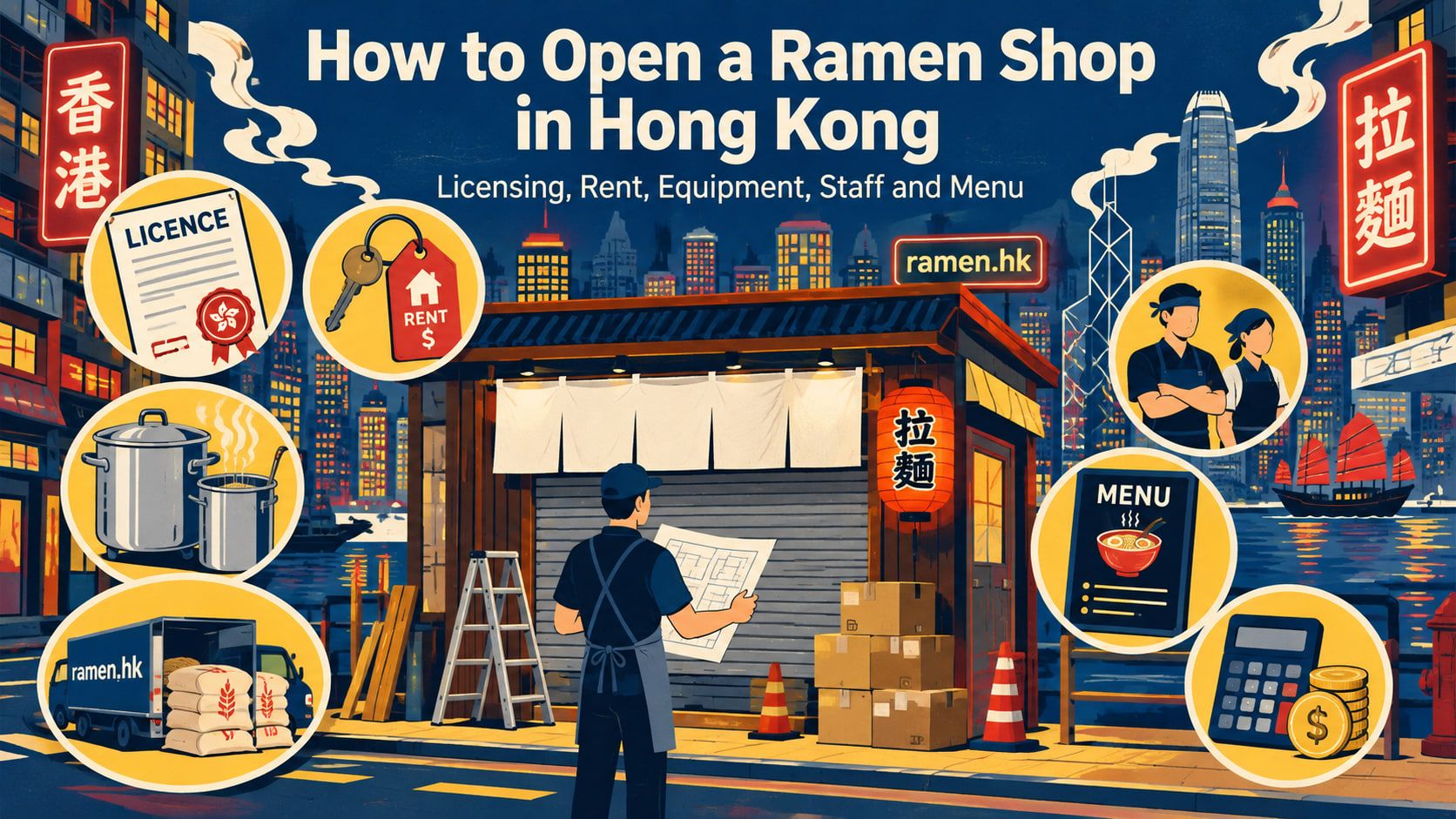
Plan a ramen business with licensing, rent, equipment, suppliers, staffing and menu decisions explained for Hong Kong reality.
Build ramen shop start-up costs from premises-specific quotes, licence needs, equipment and working-capital assumptions.
Understand Hong Kong restaurant licence options and premises checks before committing to a ramen shop lease.
Assess ramen shop rent through the actual lease, works, recurring charges and realistic seating and trading assumptions.
Evaluate a Hong Kong ramen franchise through fees, support, supply obligations and professional agreement review.
Build a Hong Kong ramen business plan with traceable costs, clear assumptions and tests for operational risk.
Assess a ramen noodle machine through model-specific space, power, training, maintenance and production needs.
Choose Hong Kong ramen suppliers through specifications, traceability, delivery terms and contingency supply.
Source wholesale ramen bowls through serving capacity, handling, cleaning suitability and replacement availability.
Explore why ramen shops close through operational risks while avoiding speculation about any individual business’s finances.