Ramen Noodle Machines: Types, Capacity and Buying Questions
Assess a ramen noodle machine through model-specific space, power, training, maintenance and production needs.
Ramen Noodle Machines: Buying, Running and Licensing in Hong Kong
A commercial ramen noodle machine lets a shop control hydration, flour blend and cut width, but in Hong Kong it also commits you to floor space, electrical load, flour storage, a trained operator and possibly a separate food factory licence if the noodles are made away from the shop. Yamato's published Richmen range illustrates the scale: the Richmen Gold all-in-one model is listed by a North American dealer at about 135 by 65 by 100 centimetres, with a 10-kilogram flour mixer producing roughly 150 to 250 portions per batch depending on noodle specification, and the manufacturer gives a 12-month warranty from installation. Buying noodles from a supplier is the alternative for most small Hong Kong shops.
This page is for Hong Kong operators deciding between in-house production, a commissary and a supplier, and for anyone pricing a machine for a business plan. It sits under opening a ramen shop in Hong Kong and connects to ramen suppliers in Hong Kong. It describes published specifications and official requirements; it does not endorse a manufacturer.
The home-kitchen rule, scaled up. Treat the machine as a second kitchen: it needs its own space, power, flour storage, cleaning routine and a person who understands dough hydration. If your unit cannot spare the square metres or your roster cannot spare the hours, buy noodles.
⚙️ 1. What the machines do
Commercial ramen machines mix flour, water and kansui into a low-hydration dough, press it into sheets, compound and roll the sheets to thickness, then cut with interchangeable blades. Yamato's dealer listing describes its machines as suited to low-water-content noodles for firm texture and able to produce Hakata-style thin noodles, tsukemen noodles and gyoza or wonton skins. A third-party guide to the same range lists cutter blades from wide flat styles to very thin Hakata cuts. The manufacturer's site describes three Richmen models: an all-in-one unit for in-shop production, a mid-sized unit for small factories or multi-outlet businesses, and an advanced all-in-one unit. The role of alkalinity and hydration in the finished noodle is explained on ramen noodles.
📐 2. Space, power and placement
- Footprint: around 135 by 65 centimetres for the all-in-one model per the dealer listing, plus working space on three sides; a third-party guide suggests a minimum of roughly 2.8 square metres.
- Power: the dealer lists 1.2 kilowatts single-phase for the North American version; Hong Kong operators need the 220 to 230-volt, 50-hertz specification and should confirm it with the supplier and an electrician.
- Weight: manufacturer documents reproduced by a third party list weights in the hundreds of kilograms, which matters for upper-floor units and lift access.
- Flour storage: dry, pest-proof and off the floor, which FEHD hygiene requirements and your own quality control both demand.
- Noise and flour dust: consider separation from the service area and from neighbours.
📜 3. Licensing and food-safety implications
Making noodles inside a licensed restaurant for consumption on the premises is generally within the restaurant licence, but the layout plan submitted to FEHD must show the machine and the flour store, and any change after licensing needs approval. Producing noodles at a separate site for supply to your own shops or to other businesses is a food factory activity and FEHD publishes a separate guide for Food Factory Licence applications. Raw noodles containing egg and kansui need chilled storage and dated rotation; the handling rules are on ramen food safety and the licence framework on restaurant licences in Hong Kong.
💵 4. Cost tiers and total cost of ownership
Machine prices are not published by manufacturers and vary with model, voltage specification, shipping, import duty treatment and installation; obtain a written quote delivered and installed in Hong Kong. Beyond purchase, the recurring costs are flour and kansui, blade replacement, servicing, electricity, the operator's hours and waste from failed batches during training. Compare the all-in cost per portion with supplier quotes over at least a year. Set it out as a tier in ramen shop start-up costs and test it on ramen shop profit margins.
🎓 5. Training the operator
Yamato runs a five-day ramen school in Japan, described on its official site, covering noodles, stock, tare, oil, toppings and plating, and it also publishes an online course; other manufacturers and suppliers offer installation training. Budget time for the operator to learn how Hong Kong humidity affects flour and dough, because hydration that works in Kagawa may not in a Mong Kok summer. Training options are compared on ramen school and training, and the home-scale version of the same skill is on homemade ramen noodles.
🧭 6. Make, commissary or buy
- Make in shop: full control and a visible selling point, at the cost of space, hours and training.
- Commissary: one machine supplying several outlets, requiring a food factory licence and chilled logistics.
- Buy: lowest capital and complexity; quality depends on supplier relationship and specification, and most Hong Kong independents start here.
- Hybrid: buy now, with a machine budgeted for a later date once turnover is proven.
Specifications are model- and market-specific. Dimensions, power and output figures on this page are from a dealer listing and third-party reproductions of manufacturer documents and refer to specific models and voltages, some for North America. Obtain the current Hong Kong specification, price and installation terms in writing from the supplier, and confirm the electrical and layout implications with your authorised person before ordering.
❓ 7. FAQ
How much does a ramen noodle machine cost? Manufacturers do not publish prices. Costs vary by model, voltage, shipping and installation; obtain a Hong Kong delivered-and-installed quote.
How many portions can one machine make? A dealer listing for one all-in-one model cites roughly 150 to 250 portions per 10-kilogram flour batch depending on specification. Output varies by model.
Do I need a separate licence to make noodles? In-shop production for your own customers is generally within the restaurant licence if shown on the approved layout. Off-site production for supply is a food factory activity with its own FEHD licence.
How much space do I need? Around 135 by 65 centimetres for one all-in-one model plus working space, roughly 2.8 square metres according to a third-party guide, plus flour storage.
Is it better to buy noodles? For most small Hong Kong shops at opening, yes. Reconsider once turnover justifies the space and hours.
how to open a ramen shop Hong Kong ramen shop startup cost ramen franchise Hong Kong ramen franchise cost ramen restaurant business plan restaurant licence Hong Kong ramen noodle machine ramen supplier Hong Kong ramen bowls wholesale Hong Kong ramen shop rent Hong Kong
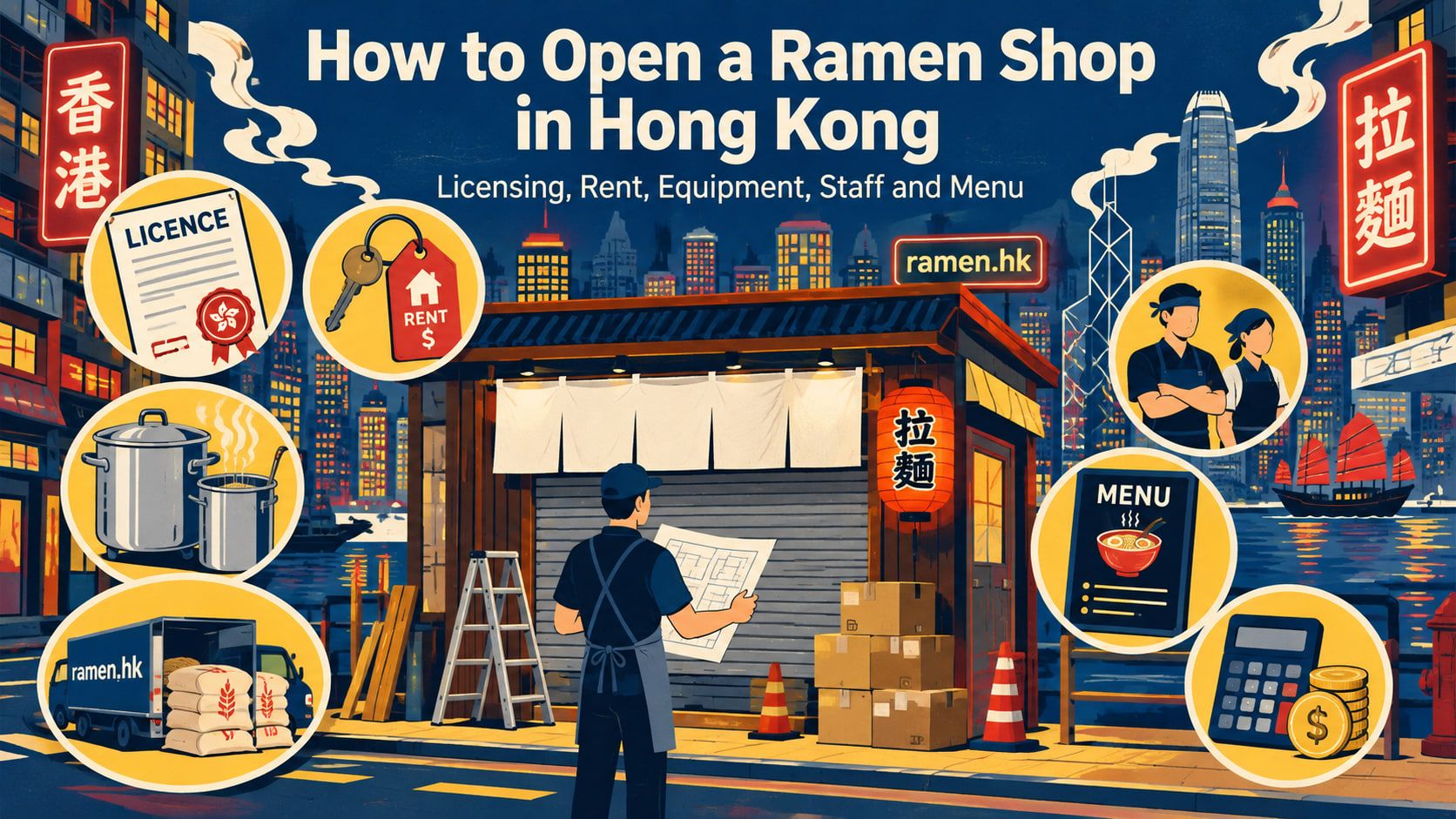
Plan a ramen business with licensing, rent, equipment, suppliers, staffing and menu decisions explained for Hong Kong reality.
Build ramen shop start-up costs from premises-specific quotes, licence needs, equipment and working-capital assumptions.
Understand Hong Kong restaurant licence options and premises checks before committing to a ramen shop lease.
Assess ramen shop rent through the actual lease, works, recurring charges and realistic seating and trading assumptions.
Evaluate a Hong Kong ramen franchise through fees, support, supply obligations and professional agreement review.
Build a Hong Kong ramen business plan with traceable costs, clear assumptions and tests for operational risk.
Choose Hong Kong ramen suppliers through specifications, traceability, delivery terms and contingency supply.
Source wholesale ramen bowls through serving capacity, handling, cleaning suitability and replacement availability.
Model ramen shop margins through actual purchasing, staffing, occupancy and turnover assumptions rather than borrowed percentages.
Explore why ramen shops close through operational risks while avoiding speculation about any individual business’s finances.