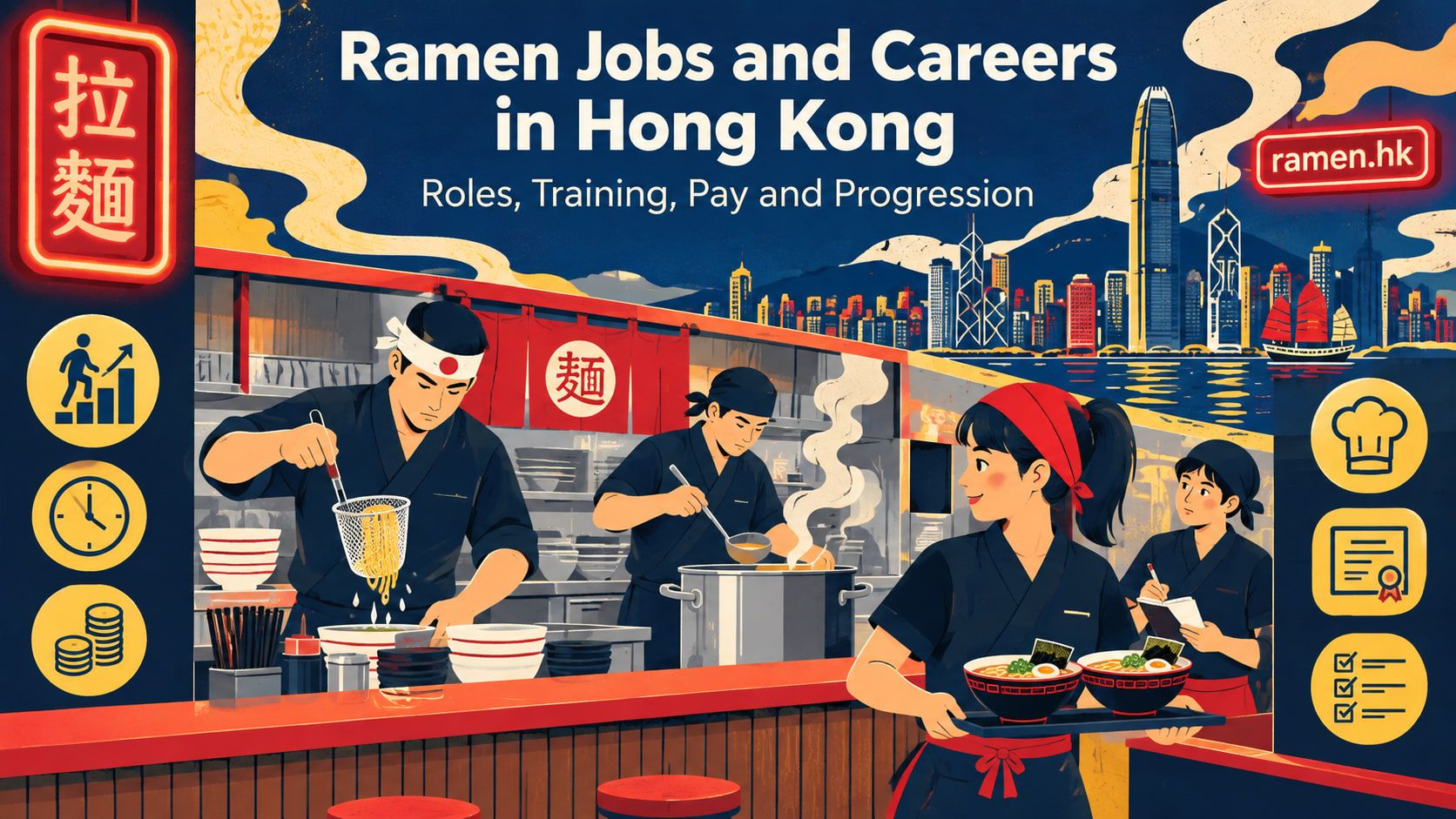
Ramen Jobs and Careers in Hong Kong
Move beyond job listings with realistic guidance on ramen-kitchen roles, training, pay factors, working conditions and progression.
Ramen Jobs and Careers in Hong Kong: Kitchen Roles, Pay, Training and Progression
Move beyond job listings with practical questions about duties, working conditions, supervised training and career development.
A good career decision starts with the actual job, not its title. Identify the employer, workplace, daily duties, hours and training before comparing pay or promotion promises. A “ramen chef” vacancy can involve a different production system from another role with the same name.
This hub connects job-search, kitchen-helper, salary, training and labour-rights guides. It does not advertise verified live vacancies, place candidates or promise progression after a fixed number of months. For the broader website, see Ramen in Hong Kong.
Choose your route:
Looking for a first job → identify entry-level duties and training.
Comparing offers → separate guaranteed pay from conditional allowances.
Considering a course → check practice time, supervision and what the certificate represents.
Already employed → keep hours, pay records and agreed terms.
Planning your own shop → learn licensing, premises and cash flow separately from kitchen work.
👨🍳 1. Identify the role and production system
Restaurant service, central food production and kitchen support can involve different skills and workplaces. Ask whether the shop prepares broth and toppings on site, receives prepared components, or combines both approaches.
| Role enquiry | Ask about | Detailed guide |
|---|---|---|
| Kitchen helper | Preparation, washing, cleaning, portioning and movement between stations. | Kitchen-helper roles |
| Ramen cook | Noodle timing, assembly, batch checks and whether stock production is included. | Becoming a ramen cook |
| Combined restaurant role | Floor duties, cashier work, kitchen support and branch rotation. | Japanese-restaurant jobs |
For search routes, use ramen jobs in Hong Kong. A broad Japanese-restaurant role is not automatically specialist ramen training, and a combined job does not guarantee future responsibility for broth production.
💰 2. Compare pay together with hours and conditions
Record basic pay, allowances, bonus conditions, hours, breaks, rest days and overtime arrangements together. An advertised maximum is not necessarily guaranteed pay, and one part-time hourly rate does not establish the market average for chefs.
- How much is guaranteed, and which amounts depend on attendance or performance?
- What are the normal start and finish times, including opening and closing tasks?
- Are there split shifts, changing rosters or transfers between branches?
- How are breaks, additional hours and public-holiday work handled?
- When is salary paid, and how are changes to terms confirmed?
Continue with ramen chef salary comparisons and working at a ramen shop. This hub does not publish an unsupported industry average.
📚 3. Training: look for supervised practice and clear assessment
A useful learning route starts with hygiene, reliable portioning, cleaning and station organisation, then adds supervised cooking tasks. Ask who demonstrates unfamiliar equipment, who checks your work and how errors are handled.
A course may teach a technique without reproducing a commercial shift. Before paying, check practical time, class size, language, equipment access and the meaning of any certificate. A certificate does not itself guarantee employment, immigration permission, competence across a whole kitchen or a promotion timetable.
Keep a learning record of tasks practised under supervision, feedback and remaining needs. Understanding noodles, broth, tare and toppings helps you ask specific training questions.
Training routes: ramen schools and training · becoming a ramen cook · food safety.
⚖️ 4. Employment rights and MPF: different tests apply
Continuous contracts from 18 January 2026
The Labour Department’s Employment Ordinance FAQ explains that an employee must be continuously employed by the same employer for at least four weeks and meet one of these working-hours conditions:
- At least 17 hours in each week; or
- Where a week has fewer than 17 hours, at least 68 hours across that week and the three immediately preceding weeks, with employment by that employer during the four-week period.
This is not any four weeks selected at will. The changes apply from 18 January 2026 and are not retrospective; earlier periods use the previous requirements. Eligibility for individual benefits can involve additional conditions.
Minimum wage coverage is a separate question
The Labour Department’s minimum-wage coverage FAQ states that statutory minimum wage generally covers employees regardless of whether they meet the continuous-contract test, subject to stated exceptions. Do not treat “not on a continuous contract” as meaning no employment protection.
Casual catering work and MPF
The MPFA defines casual employees in catering and construction as people employed day to day or for a fixed period of less than 60 days. Its employer guidance says applicable casual catering employees require contributions even when employment lasts only one day. Do not assume the ordinary 60-day rule applies to every short catering engagement. Check coverage and any exemption with MPFA.
Keep your contract, roster, pay records and relevant communications. Read Hong Kong restaurant labour rights for the wider enquiry route.
📝 5. Interview checklist and official help
Ask: “Who is the legal employer and where will I work? What are the normal duties and hours? Which pay is guaranteed? Who provides training and checks my work? How are breaks, extra hours, weather disruption and late transport handled? How is progression assessed?”
- Labour Department Interactive Employment Service: job-search and employment-service entry point.
- Employment Ordinance FAQ: rights and eligibility questions.
- MPFA Industry Schemes: casual catering employment information.
Confirm that you are permitted to undertake the work before a paid or unpaid trial. A label such as “trial” does not settle immigration, employment or payment obligations.
🏪 6. Employment experience is not a complete business plan
Running a station and running a restaurant require different responsibilities. If ownership is the goal, learn leases, licensing, staffing, supplier arrangements and cash flow separately. A successful cook is not automatically prepared for every premises or financial decision.
Continue with opening a ramen shop in Hong Kong and a ramen restaurant business plan.
❓ 7. FAQ and sources
Can I enter the industry without experience?
Some roles may provide training, but requirements vary. Ask which tasks are entry-level and which require independent competence.
Does the advertised maximum salary mean guaranteed pay?
Not necessarily. Separate basic pay from attendance, performance or other conditional amounts, and confirm terms in writing.
Does a short catering job avoid MPF automatically?
No. Special rules apply to casual catering employees; check the applicable MPFA guidance and any exemption.
Legal and MPF summaries reference the Labour Department and MPFA sources linked above. This hub does not provide live vacancies, salary survey results, placement guarantees or individual legal advice. Application depends on the actual employment facts, dates and current law; consult the relevant authority for a specific case.
"ramen jobs Hong Kong ramen chef job ramen chef salary Hong Kong how to become a ramen chef Ichiran jobs ramen kitchen helper job Japanese restaurant jobs Hong Kong ramen school ramen apprenticeship
Explore ramen jobs in Hong Kong through actual duties, work locations and the terms to confirm before applying.
Compare ramen chef pay offers through basic wages, allowances, hours and responsibilities rather than an invented average.
Plan a route towards ramen cooking through supervised practice, training options and realistic workplace expectations.
Understand ramen kitchen helper roles through duties, training, safe equipment use and the questions to ask an employer.
Compare Japanese restaurant jobs in Hong Kong through specialisms, language needs, working arrangements and work permission.
Compare ramen schools and training through curricula, practical time, teaching language and what completion actually demonstrates.
Understand working at a ramen shop through stations, shifts, physical demands, training and agreed employment terms.
Check Hong Kong restaurant labour rights through current official guidance on wages, leave, MPF and dispute support.
求職前了解職責與更表,揀工作更有把握