
Ramen Tour Japan: A City-to-City Itinerary
Compare guided and self-guided ramen tours in Japan through inclusions, dietary checks, pacing and cancellation terms.
Ramen Tours in Japan: Guided, Self-Guided and What to Check
A ramen tour in Japan can mean a paid guided tasting with a local guide, a self-planned route through station ramen streets and museums, or a multi-city itinerary built around regional styles, and the right choice depends on how much Japanese you read and how much queue time you are willing to spend. Guided Tokyo tastings reviewed by third-party sites in 2025 and 2026 typically run two to three hours, visit two or three shops, cap groups at around eight people and cost in the region of 17,000 yen per person, with train fares usually excluded; that is roughly the price of five to eight bowls bought independently. Self-guided routes cost only the bowls.
This page is for Hong Kong travellers deciding whether to pay for a guide or plan their own ramen route, and what to verify before booking either. It sits under ramen travel in Japan and draws on the city and museum pages beneath it. It describes formats and checks; it does not endorse any operator.
The compare-first rule. Before booking a tour, read what the operator says is included: number of shops, portion size, whether bowls and transport are in the price, group size and the cancellation policy. Then compare that against a self-guided afternoon at a ramen street or museum, which may deliver the same number of bowls for a fraction of the cost.
🧭 1. The three tour formats
- Guided tasting tours: a local guide takes a small group to several shops over two to three hours, often ordering small portions so guests can try multiple styles. Routes advertised by third-party platforms in 2025 and 2026 include Shinjuku, Shibuya and Ueno in Tokyo, with the meeting point confirmed after booking.
- Private guided tours: a single guide for your party, typically two hours and two shops, with the meeting point arranged after booking around your hotel location. One operator listed on a booking platform asks for contact details at booking so the guide can agree the meeting place.
- Self-guided routes: no booking, no fixed time, built around places where several shops sit together, such as Tokyo Ramen Street inside Tokyo Station or the Shin-Yokohama Ramen Museum.
- Specialist bookings: some guide services advertise tours to specific well-known shops that must be booked a month or more ahead and depend on those shops' own schedules.
🎟️ 2. What to check before paying for a guide
- Confirm whether bowls are included or paid separately at each shop.
- Confirm whether train fares are included; third-party reviews of Tokyo tastings note they usually are not.
- Ask about portion size, because three full bowls in two hours is a different experience from three mini bowls.
- Check the maximum group size and whether the tour runs with a minimum number.
- Read the cancellation policy against typhoon disruption; Hong Kong travellers in late summer should assume at least one weather risk.
- Ask how dietary needs are handled. A pork-free or wheat-free route is a different route, not a note on the booking form; see ramen allergens for the specifics to raise.
- Check the language of the guide and whether the shops have English menus, or whether you will rely on the guide for ordering.
🗺️ 3. Building a self-guided route
The simplest self-guided tour is a single location with multiple shops, followed by a day in a regional city. In Tokyo, the station cluster and the Yokohama museums are covered on ramen in Tokyo and the Cup Noodles Museum Yokohama. For regional contrast, Sapporo offers wok-fried miso, Fukuoka offers thin-noodle tonkotsu at open-air yatai stalls, and Osaka offers variety without a dominant style. The ordering mechanics that a guide would otherwise handle are on how to use a ramen ticket machine and Japanese ramen vocabulary.
Chain visits can anchor a day: Ichiran in Japan explains a system that works identically in every branch, which removes ordering uncertainty for a first bowl before you try independent shops.
⏰ 4. Timing, queues and pacing
Guided tours typically avoid peak hours by starting mid-morning or mid-afternoon, which is the same strategy a self-guided visitor should copy. Three bowls, even small ones, is a realistic ceiling for most people in one session. Shops may sell out of broth, take last orders well before closing or close on a weekday with no notice online, so a self-guided plan needs a backup shop for each stop. Counter manners, including moving on promptly when the shop is full, are on ramen etiquette.
🥣 5. Health and sodium across multiple bowls
A tasting tour concentrates several servings of soup into a short window. The general sodium evidence on ramen sodium applies with more force here: leaving most of the soup at each stop is the simplest way to keep the day reasonable, and anyone managing blood pressure, kidney disease or pregnancy should read ramen and high blood pressure or speak to a doctor or registered dietitian before planning a multi-bowl day. This is general information, not medical advice.
🧳 6. Souvenirs along the way
Tours often end at a shop or station with boxed ramen for sale. Dried noodles and powdered or paste soup are generally straightforward to bring into Hong Kong. Kits containing chilled chashu, raw-meat products or eggs are regulated under the Imported Game, Meat, Poultry and Eggs Regulations, and the Centre for Food Safety states there is no personal-use exemption from the health-certificate requirement, with penalties of up to HK$50,000 and six months' imprisonment. Read ramen souvenirs from Japan before buying; the style background for choosing a kit is on ramen types.
Tour details are platform snapshots. Prices, routes, group sizes and inclusions quoted here come from third-party platform listings and reviews dated 2025 and 2026 and change by season. Confirm every detail with the operator at booking, check the cancellation terms for weather disruption, and never assume a tour includes the bowls or the train fares.
❓ 7. FAQ
How much does a guided ramen tour cost? Third-party reviews of Tokyo tasting tours cite around 17,000 yen per person, with train fares typically excluded. Prices vary by platform and season.
How many shops does a tour visit? Usually two or three in two to three hours, often with smaller portions. Confirm with the operator.
Do I need a tour to eat ramen in Japan? No. Ticket machines, picture menus and clusters such as Tokyo Ramen Street make self-guided routes practical.
Can tours handle pork-free or gluten-free needs? Only if the route is designed for it. Ask before booking rather than noting it on the form.
Can I bring ramen kits home from a tour? Dried noodles and soup are generally fine. Kits containing meat or egg products are regulated by the Centre for Food Safety; check current rules first.
best ramen Tokyo best ramen Osaka Fukuoka ramen Sapporo ramen Tokyo Ramen Street Ichiran Tokyo ramen tour Japan Cup Noodles Museum Yokohama Ramen Museum ramen souvenirs Japan
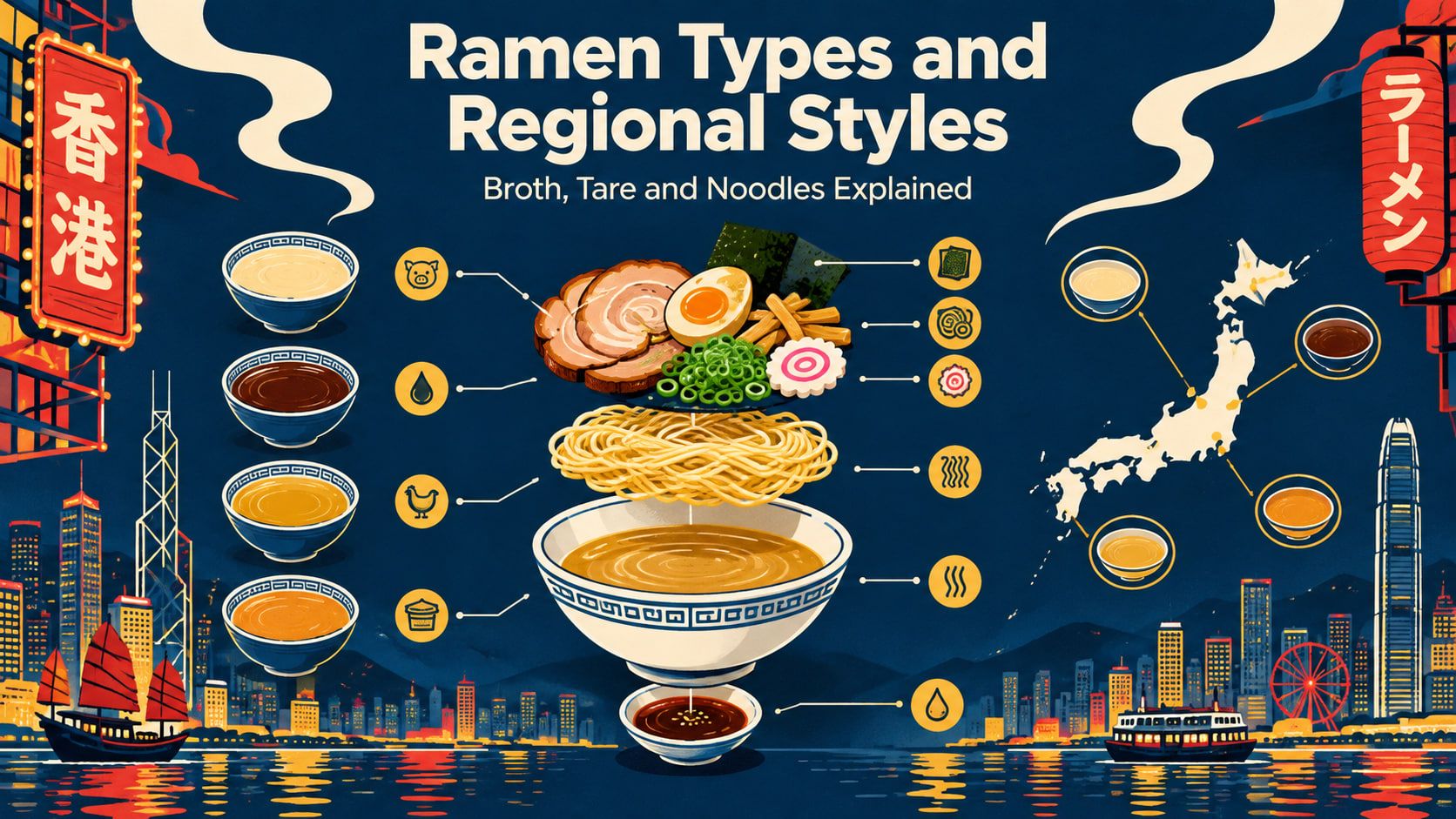
Learn to read any ramen menu confidently by understanding broth, tare, noodle texture, toppings and regional Japanese origins.

Plan a Japan ramen trip with city-specific styles, queues, museums and practical travel details.
Understand tonkotsu ramen through pork-bone broth, noodle options and the recipe details to ask about.
Explore shoyu ramen through soy-based seasoning, broth variations and the menu terms that help you choose.
Understand shio ramen through salt-based seasoning and broth choices without mistaking a clear appearance for low sodium.
Explore miso ramen through seasoning, noodle pairings and regional context before ordering or cooking it.
Understand tsukemen through its separate noodles and dipping broth, serving options and eating sequence.
Explore mazesoba through sauce, noodles and toppings, with practical guidance on mixing and ordering.
Understand abura soba through its soupless format, seasoning and the distinctions to check against mazesoba.
Explore tantanmen through sesame, chilli, recipe variations and the ingredient questions to ask before ordering.