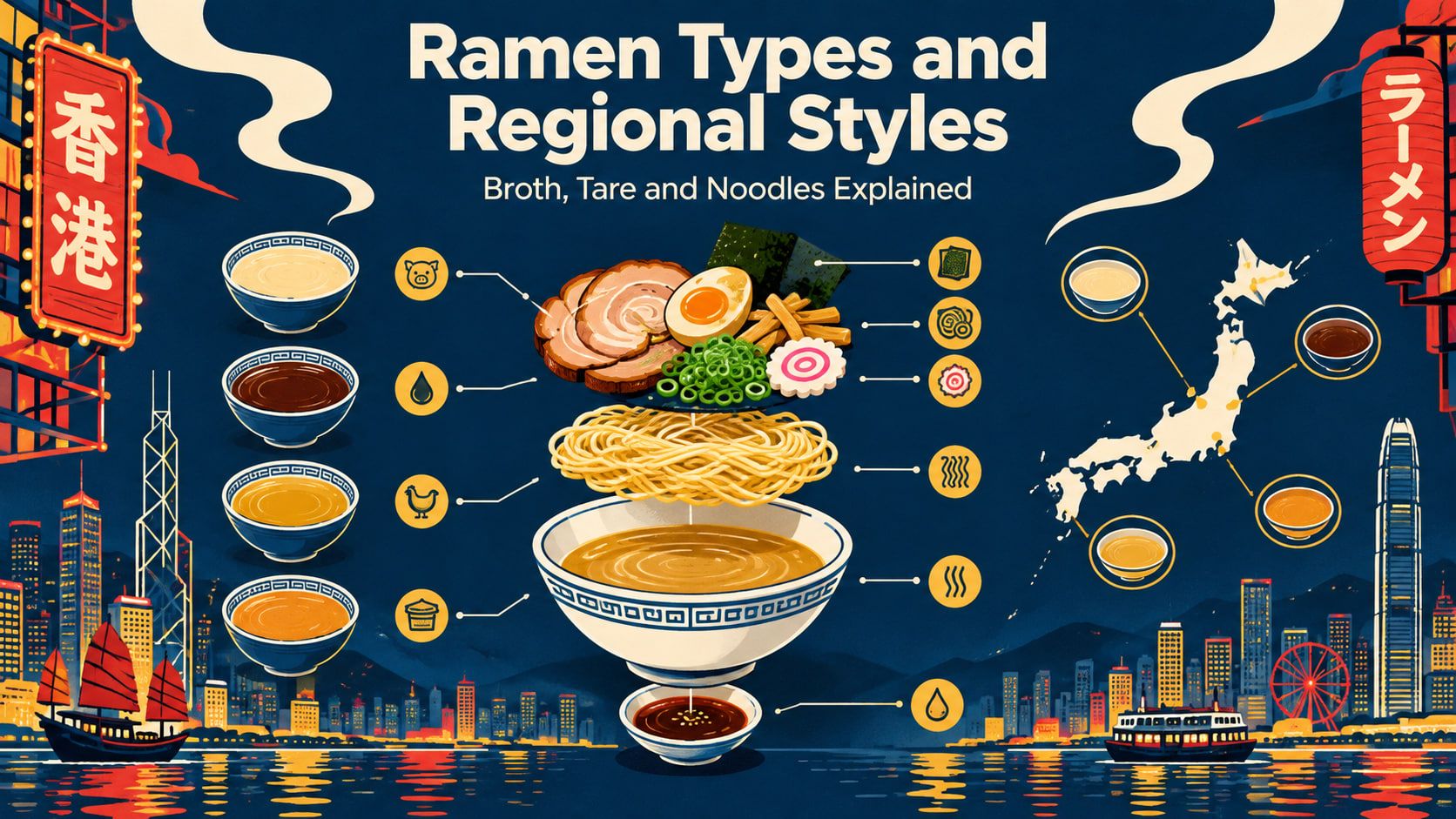
Ramen Types and Regional Styles: Broth, Tare and Noodles Explained
Learn to read any ramen menu confidently by understanding broth, tare, noodle texture, toppings and regional Japanese origins.
Ramen Styles Explained: Broth, Seasoning, Noodles and Regional Japanese Traditions
Read a ramen menu with confidence by separating the broth, seasoning, eating format and regional style.
Highlight key: styles and terminology · ordering tips · regional connections · common misunderstandings
Tonkotsu, shoyu, shio and miso are often presented as four separate kinds of ramen, but they do not describe the same part of a bowl. Tonkotsu identifies a pork-bone broth, while shoyu, shio and miso identify seasoning approaches. A bowl can therefore be both tonkotsu and shoyu.
This guide explains the categories that help you choose: broth ingredients, richness, seasoning, noodles, eating format and regional traditions. It links to individual style guides rather than treating every Japanese menu name as an entirely separate dish. For the site-wide starting point, see Ramen in Hong Kong.
Read a menu in this order:
1. What is the stock made from?
2. Is the soup clear or opaque, light or rich?
3. What is the main seasoning?
4. Are the noodles in soup, served for dipping or mixed with sauce?
5. What do the regional name, noodles and toppings add to that description?
🧭 1. What does each menu word describe?
| Category | Examples | What it tells you |
|---|---|---|
| Stock ingredients | Tonkotsu, chicken, seafood | The main broth direction, not the complete recipe. |
| Seasoning | Shoyu, shio, miso | The main seasoning source, not a fixed stock. |
| Broth appearance | Chintan, paitan | Clear or opaque broth, not a nutrition measurement. |
| Eating format | Tsukemen, mazesoba | How the noodles meet the soup or sauce. |
| Regional or school identity | Hakata, Sapporo, iekei | A tradition or common combination, with shop-specific variations. |
J. Kenji López-Alt’s Guide to Ramen Varieties separates broth richness, base ingredients and seasoning. This overlapping framework is more useful than forcing every bowl into four exclusive categories.
🥣 2. Start with the broth, then the seasoning
Pork-bone, chicken and seafood directions
Tonkotsu ramen uses a pork-bone broth direction, commonly associated with a cloudy, rich soup. Chicken paitan shows that chicken can also produce an opaque, rich broth. Fish, dried seafood, kelp and aromatics can appear alongside animal stocks.
A chicken label does not establish that pork, fish or other ingredients are absent from the whole bowl. Check the seasoning, oil and toppings as well as the stock when ingredients matter.
Shoyu, shio and miso
- Shoyu ramen: soy-sauce-led seasoning, used with different stocks and richness levels.
- Shio ramen: salt-led seasoning; not a claim that the dish is low in sodium.
- Miso ramen: miso-led seasoning, often associated with hearty bowls but not restricted to one stock.
For a direct comparison, read shoyu versus shio or tonkotsu versus chicken paitan.
🥢 3. Choose the eating format
- Soup ramen: noodles arrive in seasoned broth with toppings.
- Tsukemen: noodles and dipping soup are served separately.
- Mazesoba: noodles are mixed with sauce, oil and toppings rather than served in a conventional soup bowl.
- Abura soba: a related soupless format built around seasoned oil and tare.
- Hiyashi chuka and cold ramen: explore cold serving formats and their different dressings or soups.
Soupless does not automatically mean lower in calories or sodium. Cold noodles do not automatically mean tsukemen. Compare actual portions and recipes in tsukemen versus ramen and mazesoba versus ramen.
🗾 4. Regional traditions and specialist styles
Regional names describe common combinations shaped by local ingredients and restaurant traditions. They are useful clues, not identical recipes or proof that every restaurant in the region serves the same bowl.
- Hakata ramen: associated with Fukuoka, pork-bone broth, thin noodles and noodle refills.
- Sapporo miso ramen: associated with Hokkaido, hearty miso seasoning and robust noodles; vegetables and butter appear in common variations.
- Kumamoto ramen and mayu: explore the role of dark garlic oil and its regional associations.
- Iekei ramen and Jiro-style ramen: follow separate guides to these restaurant-school identities.
For further menu directions, explore niboshi ramen, shrimp ramen, tantanmen, spicy miso and yuzu shio.
✅ 5. Turn your preference into a useful order
“Light” can mean less oily, less salty, less thick or simply a smaller portion. Explain which one you want rather than assuming one style name solves everything.
Ask: “What is the main stock? Is the seasoning shoyu, shio or miso? Is the soup clear or creamy? I prefer [less oil / a lighter texture / no chilli]. Which bowl fits that, and what toppings are included?”
For ingredient restrictions, ask separately about every component and preparation method. See ramen allergen checks and vegan ramen styles. A style description is not certification or a safety guarantee.
❓ 6. FAQ and sources
Can a ramen be both tonkotsu and shoyu?
Yes. Tonkotsu describes the pork-bone stock, while shoyu describes soy-sauce seasoning.
Is paitan always pork broth?
No. Paitan describes an opaque broth; chicken paitan is an important example.
Which noodle thickness is best?
Neither thick nor thin is universally better. Texture, shape and how the noodle carries soup matter as a combination.
Classification and common regional examples primarily follow Serious Eats’ Guide to Ramen Varieties. This page is an introductory framework, not a complete regional catalogue or a claim that every shop follows a standard recipe. No tastings or nutritional tests are claimed.
Next: Understand the bowl’s components · Compare formats and styles · Explore Hong Kong restaurant guides
"ramen types tonkotsu ramen shoyu ramen shio ramen miso ramen tsukemen mazesoba abura soba tantanmen chicken paitan shrimp ramen iekei ramen Hakata ramen Sapporo ramen

Plan a Japan ramen trip with city-specific styles, queues, museums and practical travel details.
Understand tonkotsu ramen through pork-bone broth, noodle options and the recipe details to ask about.
Explore shoyu ramen through soy-based seasoning, broth variations and the menu terms that help you choose.
Understand shio ramen through salt-based seasoning and broth choices without mistaking a clear appearance for low sodium.
Explore miso ramen through seasoning, noodle pairings and regional context before ordering or cooking it.
Understand tsukemen through its separate noodles and dipping broth, serving options and eating sequence.
Explore mazesoba through sauce, noodles and toppings, with practical guidance on mixing and ordering.
Understand abura soba through its soupless format, seasoning and the distinctions to check against mazesoba.
Explore tantanmen through sesame, chilli, recipe variations and the ingredient questions to ask before ordering.
Understand chicken paitan through broth preparation and the checks needed before assuming a bowl is pork-free.