
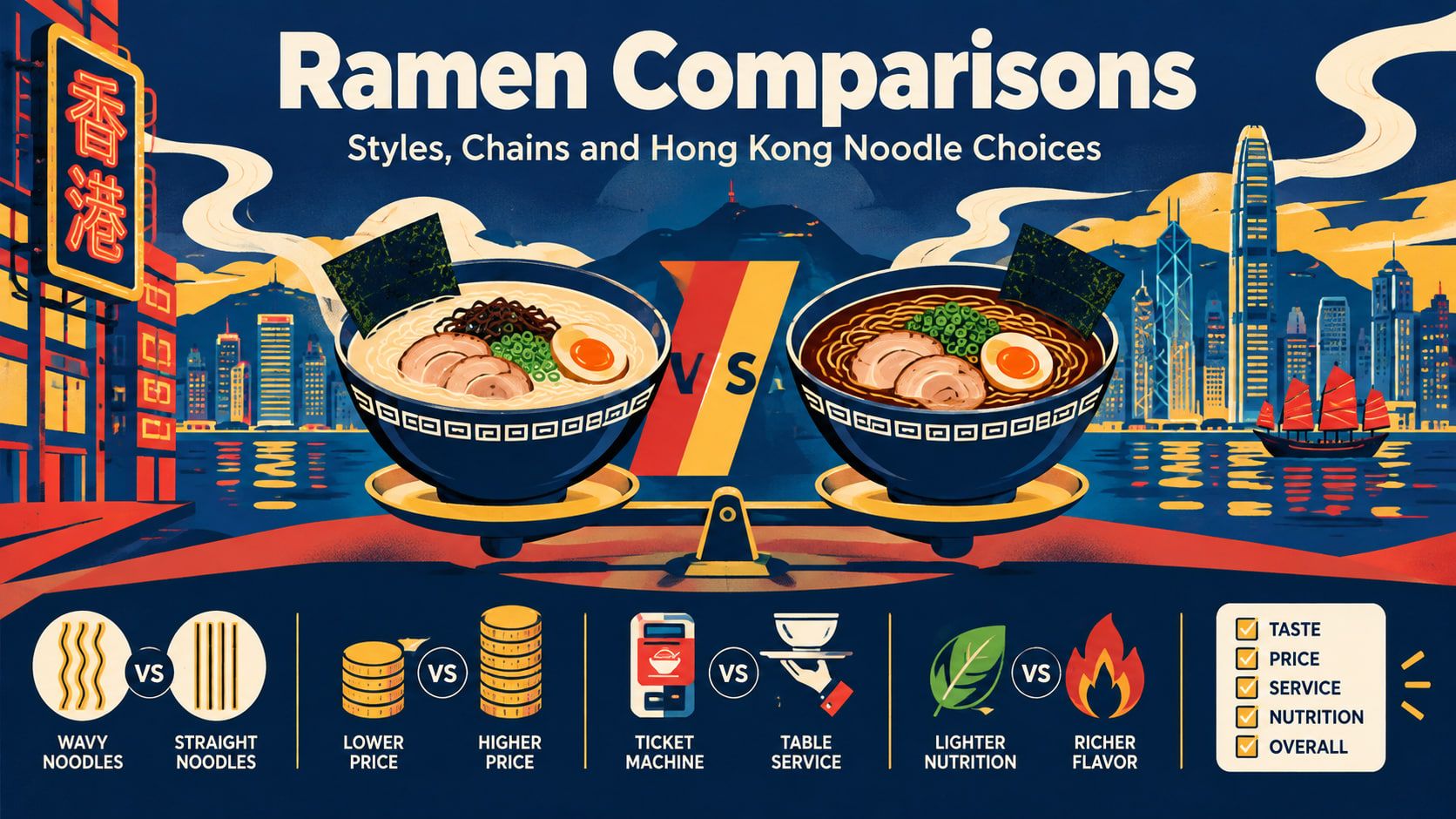
Ramen Comparisons: Styles, Chains and Hong Kong Noodle Choices
Choose with honest side-by-side trade-offs in broth, noodles, price tier, service format and nutrition—not a subjective winner.
Ramen Comparisons: Broths, Noodles, Eating Formats, Brands and Packaged Products
Choose through side-by-side differences in texture, format, total cost and ingredients—not a universal winner.
Highlight key: styles and terminology · comparison method · price and portion · limitations
A useful ramen comparison starts with what you are deciding: soup or dipping noodles, pork-bone or chicken broth, one restaurant format or another, a dine-in bowl or a packet product. Compare equivalent servings and the differences that matter to you, rather than trying to name one option best for everyone.
This hub connects the focused comparison guides and explains how to keep broth, seasoning, portions, prices and nutrition separate. It does not provide a tasting league table or infer dietary suitability from a dish’s name. For the site-wide overview, return to Ramen in Hong Kong.
Choose a comparison:
Different noodle dishes → compare ingredients, texture and serving format.
Ramen versus tsukemen or mazesoba → compare how noodles meet soup or sauce.
Tonkotsu versus chicken paitan → compare broth categories, then the actual recipe.
Shoyu versus shio → compare seasoning, not an assumed stock.
Brands → compare the specific branch, bowl, seating and complete bill.
Packet noodles → match the exact flavour, weight, serving count and preparation method.
🍜 1. Compare ramen with other noodle dishes
When the choice crosses cuisines, start with the noodle ingredients and texture, the stock or sauce, the toppings and how the dish is served. Appearance alone does not establish the recipe, and national origin does not determine which meal has less sodium or energy.
| Comparison | What to compare | Detailed guide |
|---|---|---|
| Ramen, udon and soba | Noodle composition, texture, hot or cold service, soup and dipping formats. | Ramen vs udon vs soba |
| Ramen and pho | The actual noodles, stock, herbs, toppings and serving size. | Ramen vs pho |
| Ramen and Lanzhou lamian | Noodle-making traditions, broth, garnishes and shop-specific preparation. | Ramen vs Lanzhou lamian |
| Ramen and wonton noodles | Noodle texture, broth, wontons or toppings, portion and total order. | Ramen vs wonton noodles |
These are starting questions, not fixed recipes for every restaurant. For a practical Hong Kong meal, compare travel, availability and the amount you want to eat alongside flavour preferences.
🥢 2. Soup, dipping and mixed-noodle formats
| Format | How it is served | Useful question before ordering |
|---|---|---|
| Soup ramen | Noodles in a bowl of seasoned broth. | What are the stock, seasoning and noodle portion? |
| Tsukemen | Noodles served separately from dipping soup. | What noodle weight and hot or cold options are available? |
| Mazesoba or mixed noodles | Noodles mixed with seasoning, sauce, oil and toppings rather than a conventional soup bowl. | What is included in the sauce and toppings, and how large is the portion? |
The format changes the eating sequence; it does not determine the entire recipe. A soupless dish is not automatically lower in sodium or calories, and dipping noodles are not necessarily a smaller meal.
Compare tsukemen versus ramen and mazesoba versus ramen. For the individual formats, read tsukemen and mazesoba.
🥣 3. Separate broth from seasoning before comparing styles
Serious Eats’ Guide to Ramen Varieties distinguishes broth richness, base ingredients and seasoning. Tonkotsu describes a pork-bone broth; shoyu, shio and miso describe seasoning sources. These are overlapping descriptions, not four mutually exclusive choices.
Tonkotsu versus chicken paitan
Compare the main stock ingredients and the bowl’s richness, then ask about its seasoning and oil. A chicken-based description does not confirm that all other components are free from pork, seafood or other ingredients. Read tonkotsu versus chicken paitan.
Shoyu versus shio
This is primarily a comparison of soy-sauce and salt-led seasoning approaches, not proof that one soup is clearer, lighter or lower in sodium. Both can be paired with different stocks. Read shoyu versus shio.
For the framework behind these terms, use ramen styles and ramen components. Richness is a sensory description here, not a measured calorie or fat value.
🏪 4. Compare brands and locations through published details
For restaurant comparisons, use the branch’s menu focus, customisation, seating, queue method and complete price. These are more useful than assuming every branch delivers the reputation of an overseas original.
- Ichiran vs Ippudo vs Butao: compare the published menu and service features relevant to your meal.
- Ramen in Hong Kong vs Japan: compare specific orders and locations, not simply currencies or national labels.
- Hong Kong restaurant guides: return to the operator and branch evidence.
For a cross-city price comparison, record the date, exchange-rate basis, serving, extras and applicable charges. Currency conversion shows the converted price, but does not explain operating costs, ingredient choices or profit margins.
📦 5. Compare packaged noodles by the exact product
Write down the flavour, region or version, pack weight, serving count and cooking method. A drained sauce-based product and a soup noodle are different formats even before you compare heat or nutrition.
Focused guides: Buldak vs Shin Ramyun · Ramyeon vs ramen · Ramen vs ramyeon · Instant-noodle calorie and sodium comparisons.
GovHK’s nutrition-label guide recommends first identifying whether figures refer to each 100 g/mL, serving or package. Compare like with like, then calculate what you will actually eat.
Do not compare dry-product values with prepared-product values without checking the basis. Additions such as egg, meat or cheese also change the meal beyond the packet’s figures. Manufacturer information for a matching product is more useful than an unattributed online spice number.
✅ 6. Build a fair side-by-side checklist
| Comparison field | Record for both options |
|---|---|
| Identity | The named dish, restaurant branch or exact packaged product. |
| Format | Soup, dipping or mixed noodles; preparation method where relevant. |
| Ingredients | Verified stock, seasoning, oil, noodles and included toppings. |
| Portion | Serving size and whether the figures include soup, sauces or extras. |
| Cost | The complete order through the same channel, with a date. |
| Practical fit | Travel, seating, queue, preparation equipment or storage. |
| Evidence gaps | Anything not confirmed, rather than an estimated replacement. |
Dietary constraints can make an unknown ingredient a reason not to choose; texture or broth preference can remain personal. Mark missing information as unknown, ask the questions that affect your decision, and let preferences remain preferences.
For ingredient enquiries, use ramen allergens. For interpreting nutrition beyond a simple comparison, use the nutrition and health hub.
❓ 7. FAQ
Which ramen style is best?
There is no universal winner. Start with the format, texture and flavour you want, then check practical and dietary requirements.
Is shio always lighter than shoyu?
No. They describe seasoning approaches and can be paired with different stocks and oils. Neither name establishes a nutrition value.
Is chicken paitan automatically pork-free?
The name describes the main broth direction, not every ingredient. Confirm the stock, seasoning, oil and toppings if avoiding pork matters.
Does soupless mean fewer calories or less sodium?
Not necessarily. Sauce, oil, noodles, toppings and portion size still matter. A reliable comparison needs data for the actual dishes.
Can I compare two packets using the number beside “sodium”?
First check the reference amount, serving count and whether the label describes the product as sold or prepared. The numbers must use a comparable basis.
🔎 Sources and limitations
Broth, seasoning and format distinctions draw on J. Kenji López-Alt’s Guide to Ramen Varieties for Serious Eats. Label-reading guidance uses GovHK’s consumer explanation; the CFS nutrition-labelling FAQ provides more technical detail for trade and labelling questions.
This hub explains comparison methods and links to focused topics. It does not claim controlled tasting tests, a current full-market price survey or nutrition analysis of individual restaurant bowls. Actual recipes, portions, prices and product versions may differ. Personal medical diets require advice from a qualified clinician or registered dietitian.
"ramen comparison Ichiran vs Ippudo ramen vs udon ramen vs pho ramen vs Lanzhou lamian ramen vs wonton noodles ramen vs ramyeon tonkotsu vs paitan instant vs fresh ramen

Get the direct answer first, then follow links to the deeper guide on ingredients, culture, calories or cooking.
Compare Ichiran, Ippudo and Butao through published menus, customisation, seating and ordering logistics without a winner.
Compare ramen, udon and soba through noodle ingredients, serving formats and the dietary questions worth checking.
Compare ramen and pho through noodles, broth, toppings and eating format rather than declaring one superior.
Compare ramen and Lanzhou lamian through preparation, noodles, broth and the context behind their names.
Explore ramen and Hong Kong wonton noodles through their ingredients, serving styles and practical meal differences.
Compare ramyeon and ramen through product formats, cooking methods and what the names commonly describe.
Compare tsukemen and ramen through dipping versus soup formats, noodle choices and the way each meal is eaten.
Compare mazesoba and ramen through sauce, soup, toppings and serving format without assuming soupless means lighter.
Compare tonkotsu and chicken paitan through broth ingredients, preparation and the dietary checks each requires.